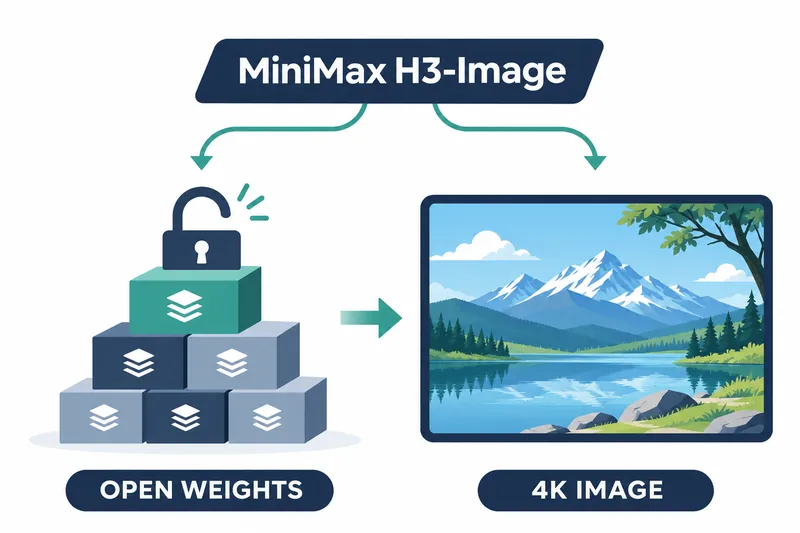
On November 11, MiniMax released H3-Image with open weights for text-to-image generation and reference-image editing. Developers and creators can download the weights for their own tools and workflows or generate 4K images via the MiniMax API.
1. Generation and editing in one model
H3-Image generates images from text descriptions and creates new results from reference images. A single editing request accepts 1–16 reference images, supporting tasks that combine multiple sources.
The model card, a document covering model details and usage, shows an example combining an empty room with furniture photos to create a living room. It targets both text-directed scenes and results incorporating existing visuals.
The model card says it generates 4096×4096 images directly, without upscaling. Its practical range is about 4 million–20 million pixels, with the best results generally near 16 million pixels. It uses 6 computation steps to complete an image.
2. Under 10 seconds for 4K generation, according to the company
The company reports generating 4096×4096 images, about 16 million pixels, in under 10 seconds, up to 5x faster than mainstream alternatives. It separately cites 1.5–2x speed in standard mode and 3–4x in fast mode.
The company says pricing is 50–70% of comparable mainstream services, with a 50% discount on standard rates for 4K and higher requests during launch week. It emphasizes speed and price to encourage everyday high-resolution production.
3. Choose the aspect ratio and size you want
The API accepts explicit width and height or an aspect ratio and area tier. The sizes below are listed for its area tiers, which select total image size by range. Combining ratio and size lets users tailor orientation and composition.
Table: API output sizes by aspect ratio
Conditions: MiniMax-H3-Image API, 2K and 4K area-tier output settings by aspect ratio
Unit: pixels
| Aspect ratio | 2K width | 2K height | 4K width | 4K height |
|---|---|---|---|---|
| 1:1 | 2048 | 2048 | 4096 | 4096 |
| 4:3 | 2368 | 1760 | 4736 | 3552 |
| 3:4 | 1760 | 2368 | 3552 | 4736 |
| 16:9 | 2720 | 1536 | 5472 | 3072 |
| 9:16 | 1536 | 2720 | 3072 | 5472 |
| 3:1 | 3552 | 1184 | 7104 | 2368 |
| 1:3 | 1184 | 3552 | 2368 | 7104 |
Width and height vary with aspect ratio even within the same area tier. The 4K tier sets total image area, not a fixed width.
Text-to-image generation and image editing use separate API endpoints. The documentation gives this example request body for text-to-image generation:
payload = {
    "model": "MiniMax-H3-Image",
    "prompt": "An orange cat lying on a windowsill basking in the sun, warm afternoon light, film texture",
    "size": "2720x1536",
    "n": 1,
    "response_format": "url",
}
By default, the API expands short prompts into detailed descriptions of the whole scene and returns the actual prompt used in its response. This prompt expansion is always applied to image editing.
Explicit width and height cannot be combined with aspect ratio and area-tier settings in one request.
4. Self-hosting requires model storage and operations
The Hugging Face model card lists the released image model file at 68.65GB. The text encoder, which converts text into model inputs, is a separate 66.7GB download from MiniMax-H3. Local prompt expansion adds an optional 17.9GB model.
MiniMax lists SGLang and vLLM-Omni as deployment tools. Other options include diffusers and ComfyUI.
High-resolution generation adds detail but requires more computation. The API avoids operating model files directly. Local deployment offers control over the environment but brings storage and accelerator operation burdens.
The model is provided under the MiniMax-H3-Image Community License Agreement.
H3-Image brings 4K generation and multi-image editing with open weights; the key choice is balancing API convenience against the control of self-hosting.