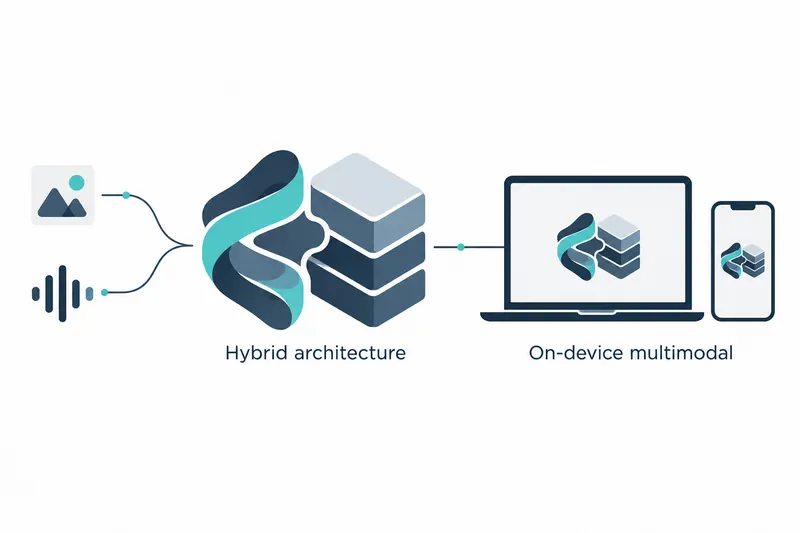
Liquid AI unveiled the LFM3 family, bringing text, images, audio, video, and decision tasks into one lineup. Developers can choose a small model for their needs and fine-tune it on their own data. They can also process data on the device running the app rather than in the cloud.
1. From a shared foundation to six models
Announced on October 27, 2026, LFM3 is a family of six models derived from LFM3-1.7B-Base. Four handle text, vision, audio, and omni input combining multiple types of information. The other two decision models build on the vision or omni models to make decisions. All are about 2B-class models. The text model has 1.7B parameters and the omni model has 2.2B parameters, the numerical values a model learns.
Both base models and post-trained models, refined after initial training, release their weights, the internal learned values. They are available through Hugging Face, the Liquid AI API, and a playground for testing models on the web.
Locally, they can run with tools such as llama.cpp and MLX. This supports workflows that ship models with apps or fine-tune them on task-specific data.
2. A hybrid architecture targeting long-context efficiency
LFM3 mixes short convolutions with two types of attention. It combines local pattern processing with broad context processing. Unlike attention spanning the full context, narrow attention works within 256 tokens to reduce long-context compute and storage costs. The architecture was chosen by weighing speed and quality across devices. According to the company, inference performance per parameter is similar to LFM2-1.2B on short inputs and about 25% faster at 8K tokens of context.
Pretraining used 22 trillion tokens. During the final 3.5 trillion tokens, high-quality data and tool-use traces were added, and context length was extended to 256K.
The key-value cache is memory that stores previous computations for reuse. The company reports the following cache memory usage with a full 128K context.
Table: Cache memory for long contexts
Conditions: Text models, key-value cache filled with 128K tokens of context
Unit: GB
| Model | Cache memory |
|---|---|
| LFM3-1.7B | 1.6 |
| Qwen3.5-4B | 4.3 |
| MiniCPM5-2B | 5.6 |
The smaller cache leaves more device memory available when storing the same context length.
3. Performance and input modes vary by task
The text model was post-trained to find and call tools. The company reports strengths in instruction following and some tool-use tasks, outperforming some larger models in browser and workflow automation evaluations. On the BFCL V4 tool-use evaluation, LFM3-1.7B scored 71.39 versus Qwen3.5-9B's 62.83. On AutomationBench, they scored 41.29 and 15.10, respectively. However, in the OpenCode environment for SWE-bench Verified, a coding evaluation using real repository issues, it scored 43.40 versus Qwen3.5-9B's 51.20. This shows variation across tasks.
The vision model supports video input and step-by-step reasoning. The company reports an average across 62 vision evaluations at least 7.4 points above similarly sized comparison models and close to a 12B model.
Table: Average vision evaluation scores
Conditions: Unweighted average of all scores across the original article's 62 vision evaluations
Unit: Points
| Model | Average score |
|---|---|
| LFM3-VL-2B | 71.4 |
| LFM2.5-VL-3B | 57.6 |
| Qwen 3.5 2B | 64.0 |
| Gemma 4 12B | 71.7 |
The audio model supports recognition, synthesis, and translation in 18 languages. The omni model processes spoken questions together with audiovisual information from video and connects them to tool calls.
4. On-device measurements and conditions
In the company's phone measurements below, the text model had the fastest token generation and lowest unified memory usage among the compared models. Unified memory is shared by the CPU and GPU. Comparisons used the same device and settings.
Table: Token generation speed and memory on a phone
Conditions: iPhone 17 Pro, Q4_0 (4-bit) quantization, GGUF model file format, llama.cpp runtime, 32K input tokens, batch size 1, 100 output tokens, GPU offloading (moving some computation to the graphics chip)
Units: Generation speed in tok/s, unified memory in GB
| Model | Generation speed | Memory |
|---|---|---|
| LFM3-1.7B | 43.6 | 1.90 |
| MiniCPM5-2B | 15.8 | 3.15 |
| Qwen3.5-4B | 15.5 | 4.53 |
| Qwen3.5-9B | 10.3 | 6.82 |
| Gemma 4 E4B | 15.4 | 6.15 |
Under the same quantization and input/output settings, the company reports 129.6 tokens per second on AMD Ryzen AI Max+ 395 and 237.1 on Apple M5 Max. Processing speed varies with the device hosting the model.
On a server, the company reports 41,710 tokens per second using one NVIDIA B300 with BF16, a 16-bit floating-point format. This was the average of 3 runs with LFM3 support in SGLang 0.5.22, using 1,024 input tokens and 256 output tokens per request, with 1,024 concurrent requests.
5. Customization benefits and device resource demands
The company reports fine-tuning a vision model for a few hours on one A100 using about 3,000 wind turbine blade images. On about 1,400 held-out images, classification accuracy rose from below 10% before fine-tuning to 67%. Detection F1, a score combining precision and recall, rose from 0.003 to 0.11, showing the effect of training on task-specific data.
Keeping customized models close to apps can reduce network round trips, but shifts compute and memory demands to deployment devices and training hardware. The company says the text model fits in about 1GB at 4-bit precision, with additional cache memory needed for long contexts.
The original article also provides the following bibliographic information for citing the model in research and documentation.
@article{liquidAI2026LFM3,
  author = {Liquid AI},
  title = {Introducing LFM3: Every Modality for Specialized Intelligence},
  journal = {Liquid AI Blog},
  year = {2026},
  note = {www.liquid.ai/blog/lfm3},
}
LFM3's central idea is not one giant model, but a wider choice of 2B-class models matched to an app's inputs and tasks for local deployment.