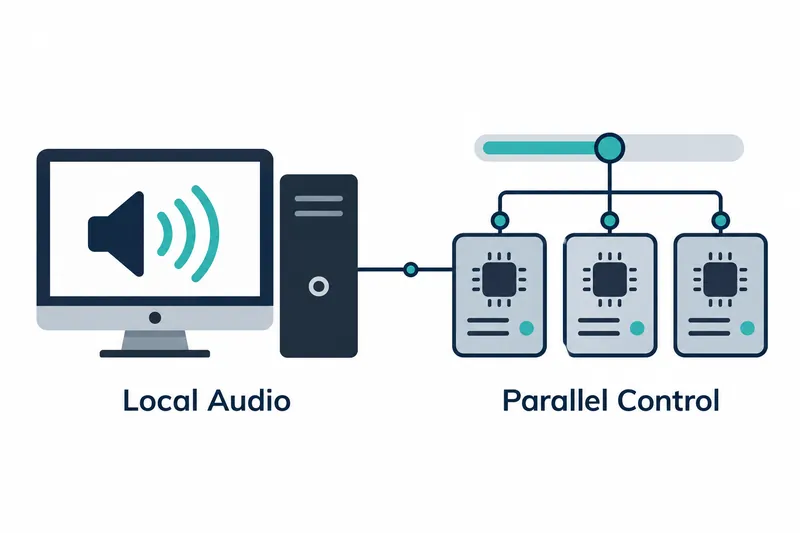
KoboldCpp adds models for local music generation and text-to-speech, plus controls for the shared cache space that temporarily stores reusable data. Audio developers can work from lyrics preparation to speech transcription in one program. Developers running parallel inference can size the shared space to fit their requests.
1. Choose music generation based on how you prepare lyrics
Released on October 31, v1.124 integrates some popular audio models from audio.cpp. Rather than merely connecting separate features, it expands model choices for built-in music generation and speech synthesis.
YuE2 has been added for music generation. Users choose configurations by downloading, saving, and loading templates. Each template specifies a combination of a music model and a language model for preparing lyrics.
Providing your own lyrics is the lightest option, using only the music model. To generate lyrics too, you can choose a configuration with a small or large language model. The release notes recommend a configuration with a small 4B language model.
2. Synthesize speech and prepare reference transcripts in one screen
Speech synthesis additions include BreezeTTS 2 and Ming 3.0 TTS. Both support voice cloning to reproduce a reference voice, as well as instruction input. The release notes mark them as recommended models.
The base Qwen3-TTS supports voice cloning, while its VoiceDesign configuration supports instruction input. Even within one family, the right configuration depends on the features needed. Choose among the new models based on whether you will use reference audio or instructions, rather than by name alone.
MusicUI, the music and speech generation interface, has also been updated to support the new models. After starting the program, open the address below in a browser. It provides a screen for selecting models and starting work.
http://localhost:5001/musicuiThe interface now includes a transcription tab using Whisper models. It can turn reference audio into text for speech synthesis models that require a transcript. Support for new models and input preparation tools together changes the audio workflow.
3. Size shared space for concurrent requests to match the workload
You can now specify the total key-value cache pool size shared by parallel requests. Instead of allocating space separately for each request, this adjusts the shared workspace for requests processed concurrently.
Below are the parallel request option and the newly added total pool size option. If no total pool size is specified, it defaults to the context size: the amount of input the model can handle at once.
--parallelrequests
--paralleltotalcontext
The release notes advise increasing the pool when all incoming batched requests are large. Large requests that cannot fit must wait. Accepting concurrent requests is therefore operationally tied to providing space to process them together.
The benefit is adjustable space for large requests; the cost is allocating a larger cache. Operators need to consider request sizes as well as concurrent request counts. This version also allows limited cache reuse in parallel request mode.
4. Choose models and hardware before running
To use the audio features, download and load your chosen model configuration. Configurations with a large language model for lyrics target large GPUs and demand more hardware than lightweight options. Preparing lyrics yourself or generating them determines both feature choice and resource demands.
You can run it by specifying command-line options or selecting a model in the graphical interface. Executables are available for different operating systems. If you do not need CUDA, you can choose the smaller non-CUDA build.
AMD users are advised to try the Vulkan option in the non-CUDA build first. Linux users can also choose a ROCm executable, and an arm64 build is available for M-series Macs. Choose a model, then select an executable suited to your hardware.
KoboldCpp v1.124 brings audio input preparation and generation into one tool and lets operators size the shared space for parallel inference to match their workloads.