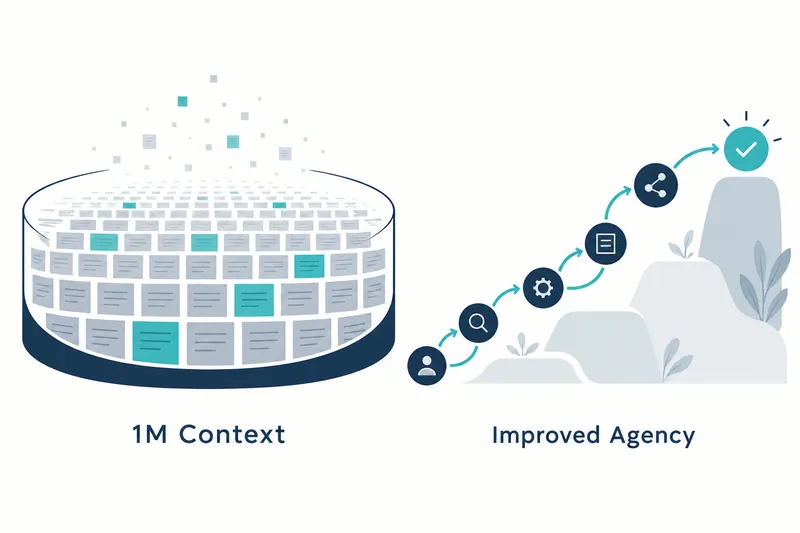
InclusionAI has released a language model improved for long inputs and multistep tasks. It offers developers handling lengthy materials another option, with higher agent and science evaluation scores, according to the company.
1. Improved agent and science evaluation scores
The model card, which provides model details and usage instructions, says the new version underwent post-training optimization. The company reports AA-Briefcase rose from about 1400 to 1524 Elo. Elo measures relative performance.
Table: Selected evaluation results for the previous version and Ling-3.1-flash-1019
Conditions: Company-reported results in the model card; before-and-after values compared separately for each evaluation
Units: Individual evaluations in %, changes in percentage points / overall index in points
| Evaluation | Previous version | Ling-3.1-flash-1019 | Change |
|---|---|---|---|
| AutomationBench-AA | 62% | 68% | +6 percentage points |
| CritPt | 18% | 26% | +8 percentage points |
| SciCode | 54% | 57% | +3 percentage points |
| Artificial Analysis Intelligence Index v4.3.2 | 41 | 44 | +3 points |
Among the three percentage-based evaluations, CritPt gained the most at 8 percentage points, followed by AutomationBench-AA at 6 and SciCode at 3. Gains varied even within science problem-solving evaluations. The 3-point rise in Artificial Analysis Intelligence Index v4.3.2 should be distinguished from percentage changes in individual evaluations.
The model page's evaluation metadata, which provides supplementary evaluation details, also lists scores of 32.8 for Terminal-Bench 4.0 and 4.3 for Terminal-Bench-Science.
The source is the Artificial Analysis leaderboard. Both results average three runs evaluating first-attempt success per task using the mini-swe-agent runner.
2. A hybrid architecture touting 1 million-token input
The model card lists 560 billion total parameters, 25 billion active parameters per token, and a 1 million-token input window for lengthy materials. Its MoE architecture selects only some experts for each input. Its attention mechanism, which focuses on important parts of the input, combines linear KDA with Gated MLA. They have 63 and 9 layers, respectively, arranged in a 7:1 ratio.
For developers processing several long documents in one input, the large window can reduce the need to split documents. Together with the evaluation gains, this points to a focus on multistep tasks involving extensive reading.
3. Inference environment and request example
The card recommends SGLang as the inference runtime for generating model responses. It says the launch-day image includes a technique that predicts multiple upcoming tokens to speed up generation, plus Hopper GPU optimizations.
The listed server configurations use 8 H200 GPUs or 4 GB300 GPUs. Parallelism settings that distribute model and expert computation across GPUs match each GPU count. According to the company, optional Hopper optimization raises output token generation speed by about 10% at batch size 1, processing one request at a time.
The card's request example follows. The model name and sampling settings, which determine how the next token is selected, are reproduced exactly from the original example.
curl -s http://localhost:30000/v1/chat/completions \
  -H "Content-Type: application/json" \
  -d '{"model": "Ling-3.1-flash",
       "messages": [{"role": "user", "content": "What is the capital of France?"}],
       "chat_template_kwargs": {"enable_thinking": true},
       "stream": true,
       "temperature": 1.0,
       "top_k": 20,
       "top_p": 0.95}'
4. Performance gains and operating costs
Long inputs and higher evaluation scores benefit multistep tasks involving extensive materials. Yet computing with only some parameters still requires resources to hold all weights, the numerical basis of the trained model. The repository occupies about 574GB, with weights split across 54 files. Self-hosting teams must weigh memory and multi-GPU deployment costs as well as throughput.
The weights are listed under the MIT license.
Deployment check: The card describes 1 million tokens, but the repository's maximum position setting is 262144. The launch example also uses an earlier model's path and name. Verify supported input length and model selection before deployment.
Evaluation status: The two terminal evaluation results mentioned above are marked as unverified in the page metadata.
The choice of Ling-3.1-flash-1019 hinges on whether its gains for tasks using lengthy materials justify the cost of operating multiple GPUs.