goose is an AI agent tool that connects models and tools to perform development tasks. This version extends request tracing information to tool calls. Subagents assigned parts of a task follow their parent's execution and approval rules.
1. Gateway connections become declarative
Released on October 16, 2026, goose 1.55.0 adds AIgateway as a declarative provider. Declarative means expressing the desired setup in configuration rather than writing each connection step. The release notes do not provide configuration entries, code examples, or migration steps for registering it.
The update also respects image support declared for custom models. Connecting a model and accounting for the inputs it accepts are separate issues. This change is relevant because it applies the connected model's declared capabilities to actual behavior.
2. Request trace context reaches tool calls
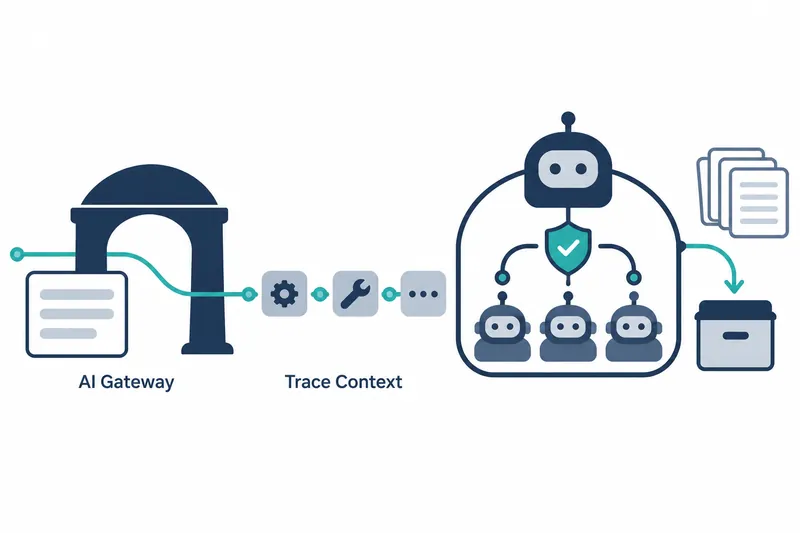
ACP is the interface for sending prompts to an agent, while MCP is the interface through which the agent calls external tools. This version passes incoming tracing information through to downstream tool calls. This preserves clues linking a request to the same task as it crosses boundaries.
The W3C trace context used here is contextual information for linking and tracing requests across components. It does not guarantee successful tool execution. Instead, it provides a broader basis for examining the route a request took.
The provider's request identifier, x-request-id, is now exposed in responses and errors. This is separate from trace context propagation, so it should not be read as passing this identifier itself to tool calls. It adds a clue for distinguishing provider requests in both successful responses and errors.
3. Automatic compaction has a default ceiling of 225000 tokens
The default ceiling for automatic compaction is capped at 225000 tokens. Tokens are the units a model uses to process text, and automatic compaction reduces the context of long conversations. This figure is not a model input limit, a conversation cutoff length, or a measurement of processing speed or performance.
Cost estimation now accounts for pricing tiers applied to long contexts. This change concerns billing calculations for long inputs. It is not a result showing how much automatic compaction reduces costs.
4. Subagents are bound to their parent's approval rules
Subagents are supporting agents assigned portions of a larger task. This version binds them to their parent's hooks, execution mode, and approvals. Hooks are processing rules triggered at specific points during execution. The aim is to keep delegated work within the controls set by the parent.
Reasoning and steering are now prevented while waiting for tool approval. This restricts reasoning and steering during approval waits. It should not be interpreted as meaning that all execution stops.
Meanwhile, background subagents have been removed. Subagent changes therefore include the removal of related functionality as well as stronger control rules.
Pending tool processing now finishes before the maximum turn count is enforced. A turn is a unit for counting an agent's work progress. This change clarifies the ordering of turn limits and tool processing already underway.
5. Assess diagnosis and delegation separately
To inspect a problematic request's route, first check the trace context extending to tool calls. To distinguish provider requests, check the request identifiers exposed in responses and errors. Before delegating work, consider both the application of parent execution and approval rules to subagents and the removal of background subagents. Since both changes are recorded together, stronger controls should not be taken to mean expanded delegation capabilities.
This update combines the convenience of configuration-defined connections with stronger request tracing continuity and control boundaries for delegated work.