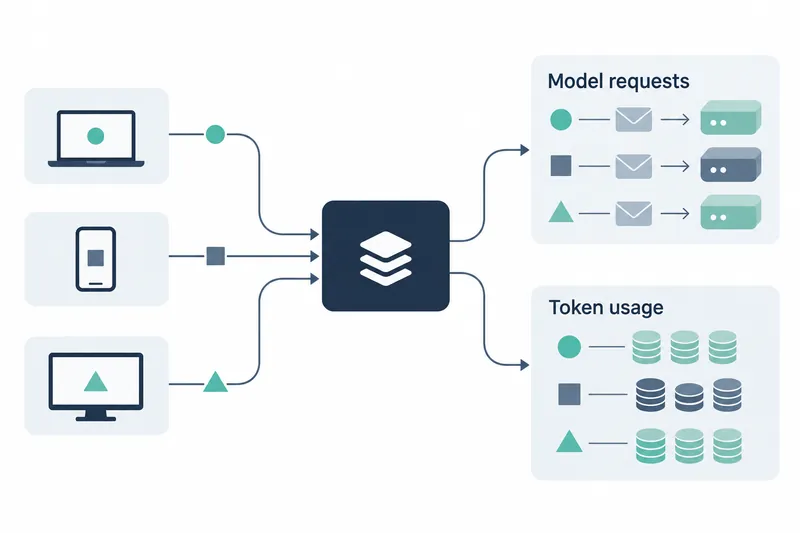
GitHub has added model request and token totals by development tool to Copilot usage reports. Administrators can review usage, tool support, and operating policies even for tools that use Copilot models outside code editors.
1. Tracking usage outside code editors
GitHub announced the totals_by_client array for per-tool aggregation in its October 23, 2026 changelog. It covers 1-day and 28-day reports for enterprises, organizations, and individual users. In 28-day reports, the array appears in each day's day_totals entry.
Tools outside code editors often did not send editor usage records and were missing from existing per-editor totals. This change fills that gap by counting model requests on the server. Administrators can compare requests and tokens by tool to see which tools drive Copilot usage.
The new array is an addition to existing reports. Existing fields remain unchanged, and the new array is empty when there is no usage to report.
2. Request counts, tokens, and model selection
Each entry includes the requesting tool, successful model requests, distinct sessions, prompt and output tokens, and average tokens per request. Tools such as OpenCode and Claude Code are covered. Unrecognized tools are grouped under other.
Request counts and token usage are also broken down by model. The model selection method is user_selected when explicitly requested by the user and auto when selected automatically.
Copilot Code Review and Copilot Cloud Agent report product_selected because the product chooses the model. For code review, the model name is reported as unknown.
Unlike existing activity metrics that count tasks started by agent apps on GitHub, the new totals focus on model requests and tokens. Administrators can examine model usage by tool alongside task-level activity.
3. Authorized users can query the API
Queries require the enterprise's Copilot usage metrics policy to be fully enabled. According to the changelog, enterprise owners, billing managers, organization owners, and users with custom enterprise or organization roles granting access to view Copilot metrics can use it.
The documentation gives the following request example for an enterprise 1-day report. The date is specified in day, and the API version header is unchanged from the documented example.
curl -L \
  -H "Accept: application/vnd.github+json" \
  -H "Authorization: Bearer <YOUR-TOKEN>" \
  -H "X-GitHub-Api-Version: 2026-03-10" \
  "https://api.github.com/enterprises/ENTERPRISE/copilot/metrics/reports/enterprise-1-day?day=DAY"
The response contains a download link for an NDJSON report, with one JSON object per line.
According to the documentation, enterprise 1-day reports provide data from October 10, 2025 onward. Historical data can be retrieved for up to 1 year before the current date.
4. More evidence for support policies, more report processing
Per-tool totals give administrators more evidence to review supported tools and operating policies against actual usage. Regular analysis requires retrieving a link from the API response, downloading the report file, and processing it. These links are signed URLs that expire, allowing access for a set period, so downloading must also be part of operations.
When interpreting request_count, remember that it counts model calls, which can occur multiple times for one prompt, so it cannot be compared directly with prompt or interaction counts. Tool classification is approximate, based on integration identifiers—strings in requests that distinguish tools. It is not a verified tool identity established by GitHub.
The key change broadens Copilot usage tracking beyond its editor focus to model usage by tool, strengthening the evidence behind support policies.