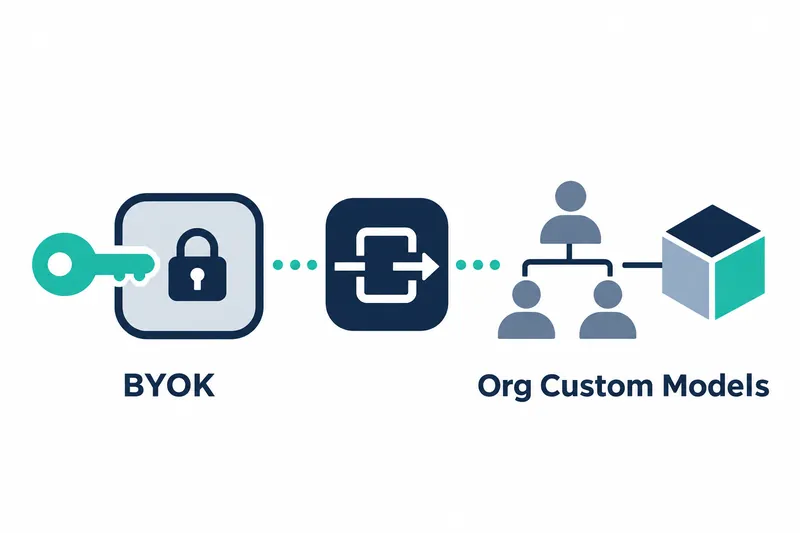
GitHub added metrics to the Copilot usage API to separately identify requests handled by developers' personal keys or local models and by organization custom models. Enterprise and organization administrators can distinguish these from Copilot-provided model usage to examine usage paths, cost attribution, and how costs are allocated in reports.
1. Two BYOK paths tracked separately
In its November 3, 2026 changelog, GitHub said the new metrics are available in both enterprise and organization reports. They appear in per-user and aggregate reports, for both daily and 28-day periods.
Local BYOK lets developers connect their own provider keys or local models. Once configured in the client, requests from Copilot CLI or the GitHub Copilot app go directly to that provider or local model.
Administrators configure organization custom models in GitHub settings. Requests pass through GitHub to the organization's provider, allowing GitHub to observe them server-side. Usage on this path is therefore recorded across client types, including IDEs.
2. User activity, request counts, and token counts
In per-user reports, used_local_byok indicates whether the user sent any local BYOK requests through the CLI or app that day. The totals_by_local_byok breakdown groups session, request, prompt, and token counts by BYOK type and by CLI or app in per-user and aggregate reports.
Active user counts deduplicate users and are provided by day, calendar week, and calendar month. These counts are available in aggregate reports.
Organization custom models are identified by is_custom_enterprise_model being true in per-model breakdowns. If the same model is used both as a Copilot-provided model and as a custom model, separate entries appear. Custom model entries contain actual request and token counts.
3. Existing totals stay the same, but cost interpretation changes
This change does not add new usage to existing aggregates; it breaks down usage already included in the totals by path. Local BYOK usage is part of existing CLI and Copilot app totals, and organization custom model usage is already included in per-client totals. The new metrics thus help distinguish usage sources and who bears the costs.
Administrators can examine Copilot-provided usage separately, making per-user Copilot costs easier to interpret. Costs for requests sent to their own providers must instead be checked in those providers' bills, while free local model usage can also be viewed separately.
Users can also be grouped by BYOK or custom model usage and compared against existing Copilot usage metrics. Seeing who sends requests through which paths can also help check usage against an organization's BYOK policies.
4. Retrieving API reports and access requirements
The reporting API returns download links that expire after a set time. You can request daily reports or reports for the latest 28 days for enterprises and organizations.
According to the documentation, enterprise daily reports are available starting with October 10, 2025 data, with access to data up to 1 year before the query date. The latest 28-day report covers a full 28 days ending on the most recent date for which processing is complete.
Enterprise reports are available to enterprise owners, billing managers, or users granted permission to read these metrics. Organization reports are available to organization owners and users with permission to read that organization's metrics. The Copilot usage metrics policy must also be enabled across the enterprise.
Here is an example request for the latest 28-day user report.
curl -L \
  -H "Accept: application/vnd.github+json" \
  -H "Authorization: Bearer <YOUR-TOKEN>" \
  -H "X-GitHub-Api-Version: 2026-03-10" \
  https://api.github.com/enterprises/ENTERPRISE/copilot/metrics/reports/users-28-day/latest
5. Telemetry status and rollout timing guide interpretation
Local BYOK depends on usage records sent by the client, so usage or token counts may be underreported if telemetry is disabled or some providers do not report token counts. Organization custom model indicators will not be backfilled into reports for dates before this rollout.
The key benefit of the new metrics is revealing processing paths without changing existing usage totals, enabling closer examination of costs and usage policies.