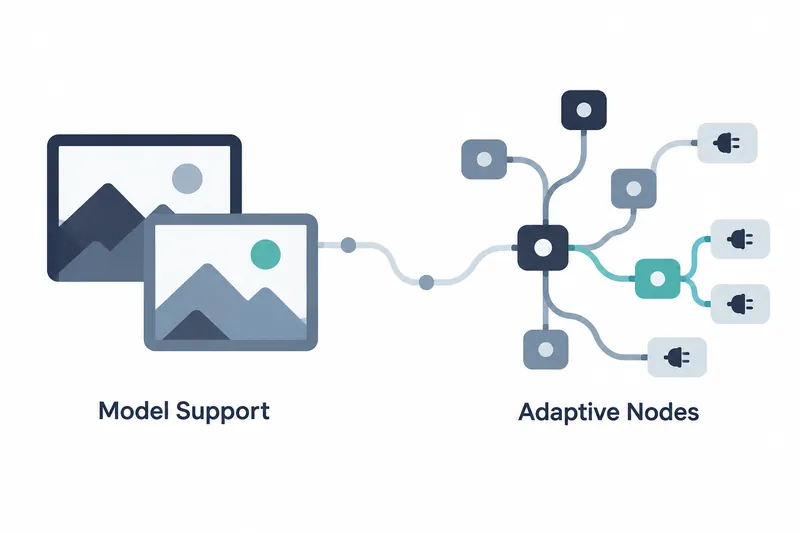
On October 27, ComfyUI released a new version expanding image editing and connections to external generation services. Developers building image and video workflows can adjust editing strength or connect new generation services. Memory handling for model execution has also improved.
1. MOSS-Image gains more editing controls
v0.43.0 adds controls for MOSS-Image color depth, which determines the number of color levels, and image strength settings. It also supports RoPE scaling. Beyond adding model support, it expands the settings available during image editing.
LoRAs that add editing characteristics to models and dedicated model merge nodes are also supported. Settings for editing strength on existing images arrive alongside tools for combining models. The release notes also report a slight reduction in MOSS-Image peak memory usage.
2. FIBO 2.0 adds both model support and service connections
FIBO 2.0 model support has also been added. The release changes scaling for positional information and fixes handling of negative prompts, which specify what to avoid in text-to-image generation. Support arrives alongside changes to how generation conditions are handled.
Bria partner nodes now include FIBO 2.0 image generation and editing. Nodes are functional blocks that form a workflow; here, they connect to external services. Both direct model use and partner service access have expanded in the same release.
3. Qwen inference and memory management also get updates
Qwen 3.x gains adaptive tree-based MTP, a method that predicts multiple tokens together while exploring candidates as branches. The release describes it as the third performance improvement for this model family. Beyond image model support, the changes refine inference during generation.
Memory changes synchronize graph cleanup during prefetching, coordinating the computational structure linking execution steps. They also align transfer operations before memory handoff. An initial dynamic KV cache stores reusable inference information in graphics memory.
The announcement provides no inference speed or memory savings measurements or test conditions, so the extent of improvement needs to be assessed in each working environment.
4. More video and image partner services are available
There are 16 partner node changes. FLUX 3 Video gains 2K and 4K resolution options, and Kling 4.0 gains new nodes. Video workflows gain both new generation service connections and more output resolution options for existing services.
Image workflows gain Ideogram nodes for generating vector images, which use lines and shapes, while video upscaling gains new ClarityAI nodes. Connections extend beyond generation to alternative image output formats and video post-processing that refines generated results.
5. Voice and sound effect connections come with authentication and network fixes
HeyGen Voice gains instant voice cloning and text-to-speech. Mirelo SFX nodes add more connection points for sound effect workflows. This expansion of partner nodes covers voice and sound effect production as well as images and video.
Connection management changes address login token refresh for partner nodes and make clients follow environment variable settings for routing through a proxy, or intermediary server. Alongside new service features, the release refines authentication maintenance and network configuration handling.
More options mean a wider choice of models and services suited to a task. They also expand what developers must select and manage, from model editing settings to external service authentication and connections. Adoption decisions therefore call for reviewing both generation and editing needs and service connections.
This feature-focused update expands the choice of generative models and external nodes while also revising memory handling and execution paths.