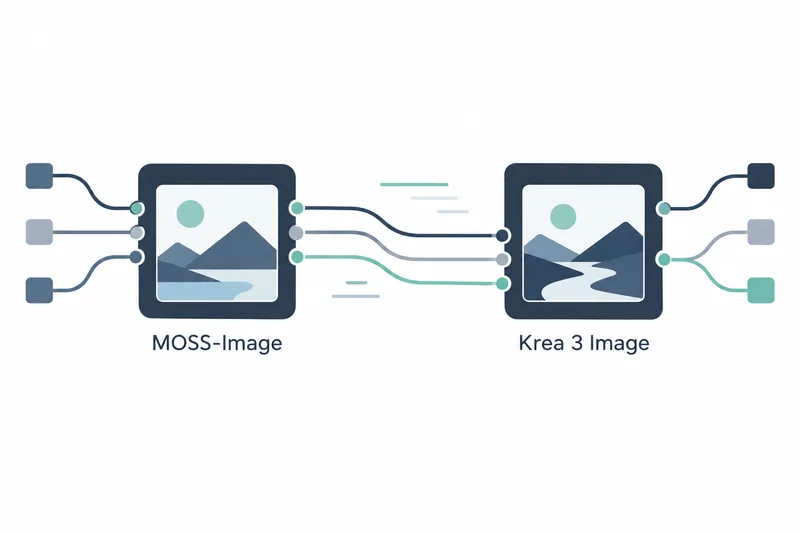
Image generation tool ComfyUI has expanded support for locally run models and external image services, while speeding up some text generation tasks. Developers designing image workflows need to consider execution location and cost alongside model selection.
1. MOSS-Image gains built-in support
Released on October 18, 2026, this version adds built-in MOSS-Image support. According to the support proposal, the newly implemented core is a diffusion transformer that generates images. It uses the existing Qwen3.5-9B text encoder to turn sentences into numbers the model can use.
Users can select the moss_image type in the text encoder loader. Model file locations and example workflows are linked in the support proposal. For layout control, feed an overall description and rectangular region data into the experimental MOSS-Image Layout Prompt node to create structured layout instructions.
The image generation component supports bfloat16 and float32 for inference. These data types define how numbers used in calculations are represented.
2. Krea 3 Image connects an external service
Krea 3 Image is a node that connects an external image service to a workflow of processing units. Without an image connected, it generates a new image from text; with one connected, it edits the existing image. Up to 8 input images are numbered in connection order.
Prompts can reference images using notation such as @Image1. Referencing an unconnected number causes an error. The feature for preserving areas outside the editing region is off by default and requires at least one image.
The default mode prioritizes speed, while the mode that plans edits in greater detail takes longer, according to the node description. It also notes that the same seed does not reproduce the same image because the service rewrites the prompt before generation.
3. Qwen improvements were verified in text generation tests
The Qwen 3.x performance proposal includes the earlier Part 1 changes. It refines the cache that reuses previous calculations and small-scale generation operations. Crucially, the reported results come from text generation tests, not the full image completion process.
The first test lists Linux, RTX5090, and 96GB, with an image-input creative writing task. It uses Qwen 3.8 with 4-bit weights and 8-bit intermediate values. Runtime was 45.26 seconds before the changes, 32.48 seconds for Part 1, and 24.99 seconds for Part 2. Displayed generation rates were 60.05, 88.51, and 108.27 per second, respectively.
A separate test on the same hardware and model configuration used a context of 30,000 tokens and an output of 4,000 tokens. Tokens are units into which a model splits text for processing. With --use-ck-attention enabled, runtime fell from 110.37 seconds to 35.29 seconds. Different task conditions prevent direct comparison with the first test.
A creative writing test on Windows, RTX5080, and 96GB used Qwen 3.5 with 6-bit weights and 8-bit intermediate values. Runtime fell from 22.06 seconds to 16.07 seconds, while generation speed rose from 104.66 to 130.10 per second. These are examples from the submitter; gains in other environments were not provided.
4. More options require distinguishing execution costs
The benefits are more options for running models locally and more external editing features. However, external service nodes upload input images, send prompts, and incur fees. The pricing formula varies with resolution, processing mode, and the number of reference images. Broader support should not be mistaken for more free, locally run features.
The check for CPU support for low-precision computation was also revised. This excludes unsupported computation paths rather than adding new acceleration. Below is an unchanged excerpt from the beginning of the support-checking function.
def supports_nvfp4_compute(device=None):
    if is_device_cpu(device):
        return False

    if not is_nvidia():
        return False
This release broadens image generation options; adoption decisions should weigh condition-specific text generation gains separately from external service costs.