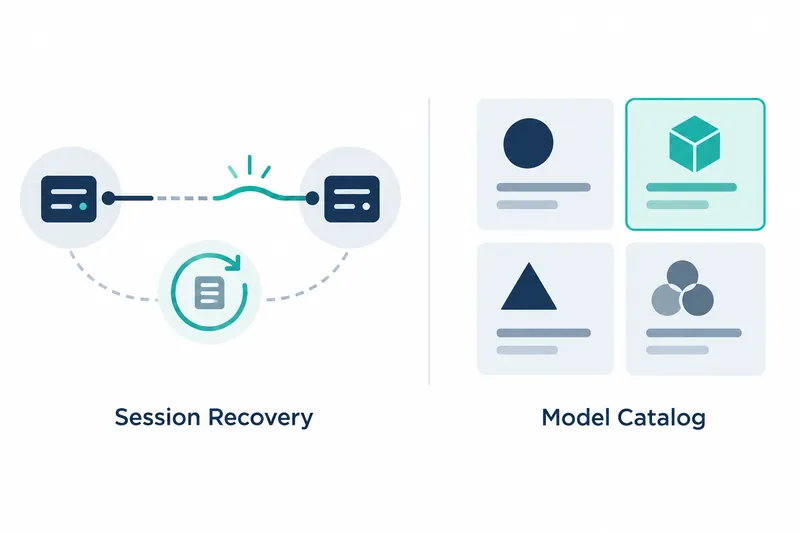
The new version of Cline's agent development toolkit reconnects to running tasks and retries some interrupted model requests. Developers integrating agents can regain access to ongoing work and should also review the updated model list and defaults.
1. Reconnecting to sessions with ongoing work
Released on October 26, Cline SDK v0.2.0 reconnects to the existing runtime when starting a session that already has work in progress. Previously, replacing the runtime left the original task running but inaccessible, while conversation history was written to stale state. The new approach routes connections back to where the work continues.
The hub that routes requests to client programs also accounts for connection status. It tracks clients that registered capabilities for a session and sends requests to the first one still connected. This includes clients that join after work has already started.
If no clients remain connected, requests fail quickly with an actionable message for the user. This replaces behavior that waited indefinitely for a response. Reconnection and request routing now locate ongoing work and connected clients.
2. Retrying requests that produced only reasoning
A turn, or one response cycle, becomes eligible for retry if the model emits only reasoning before the connection drops. The partial reasoning is discarded and the turn starts over. This recovers interruptions during preparation, before an answer is produced.
Model requests allow up to 3 retries after the initial attempt, down from 5. Retry coverage expands while the retry count falls. This may reduce waiting through repeated failures, but prolonged temporary outages may surface as failures sooner.
Failed attempts are recorded in Langfuse traces, while user-canceled requests are no longer reported as errors. This preserves failure records while reducing the mixing of user cancellations with errors.
3. Adjusting compaction timing to actual payload size
Message size estimation after the first compaction, which shortens the conversation, has also changed. It now uses the messages actually sent after tool results are truncated. The company says the previous method overestimated size by about 7 times, triggering compaction again after every few tool uses.
By aligning estimates with the content actually sent, this fix helps reduce unnecessary repeated compaction. It changes the basis for deciding when to compact during tasks that use tools frequently.
Automatic compaction is now skipped when the model's input limit is unknown. User-requested compaction and compaction to recover from exceeding the input limit still work. Proactive, limit-based compaction is treated separately from compaction performed when needed.
4. Checking default changes rather than model counts
The model catalog changed from 7,041 entries to 6,457. Its composition also changed: Liquid Inference was added as a provider, a service supplying models, while the Llama provider was removed. Reflection Beam and Nemotron 3.5 Lightning were among the additions to the free list.
The ClinePass default model changed to Kimi K3.1 Pro. MiniMax M3.1 Flash and DeepSeek V4.1 Flash 1017 were also added to the list. Mimo V2.5 and V2.5 Pro were removed from the existing list.
Default models also changed for 56 other providers. Beyond the smaller catalog, the defaults now select different models, making them a direct concern for integration developers. When updating, check both the model list and the default model for your provider.
5. Checking model selection information and execution conditions
If OpenRouter has no matching entry for a recommended model, capability information is fetched from the Vercel catalog. This fallback fills in recommended model information, adjusting how supported capabilities are populated as well as the model list itself.
The max reasoning effort setting, which controls the model's level of internal deliberation, is now passed unchanged to the provider. Previously, the adapter layer that passes values between components converted it to xhigh. This fixes the path by which the developer's chosen setting reaches the model provider.
Execution conditions also need checking. Starting a session with a prompt is rejected if work is already in progress. Turns that have already produced text, media, or tool calls are not retried.
This update restores access to ongoing work while adjusting retry and compaction criteria alongside model selection defaults.