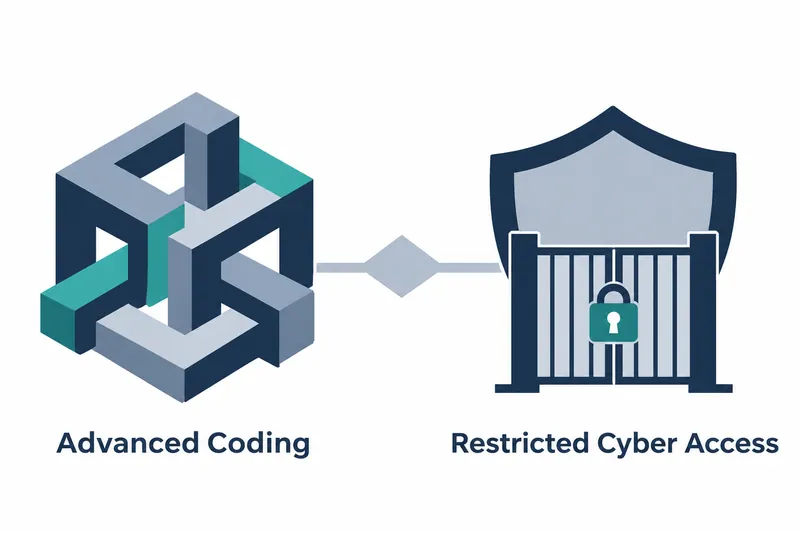
Anthropic unveiled two AI models for demanding technical work. Developers can assign complex coding to the general-purpose model and apply for access to the security and life sciences research model through organizational vetting.
The company recommends starting with its existing flagship, Opus, for routine coding and choosing the new models for complex, open-ended work. This adds options for adjusting costs to task difficulty.
1. Same base model, different security access
Claude Fable 5.2 and Claude Mythos 5.2 share a base model. Fable uses classifiers that identify risky requests and block most high-risk cyber activities and biological research tasks.
Mythos omits some security and biology safeguards. Organizations pursuing beneficial uses can apply for access through a vetting program.
Base pricing is $8 for input and $40 for output per 1 million tokens. The company says output is up to 30% faster than the previous generation.
The optional fast mode boosts generation speed by up to 2.5x, according to the company. It costs $16 for input and $80 for output for the same token count.
Effort settings can lower costs per task, while the more expensive fast mode improves response speed. Developers must choose whether to prioritize cost savings or shorter waits.
2. Improving coding performance and cost per task
The company reports that the new model outperformed its predecessor and existing flagship on FrontierSWE v2. Effort controls how much work a model puts into solving a problem. The results below use each model's highest setting.
FrontierSWE v2, safeguards enabled, highest available effort for each model
| Model | Score |
|---|---|
| Fable 5.2 | 69.9 |
| Fable 5.1 | 56.3 |
| Opus 5.5 | 62.3 |
FrontierCode 2.0 evaluates whether project maintainers would merge code changes. The company reports that the new Fable scored 45.3% at high effort, close to Opus 5.5's 45.5% at maximum effort, at roughly half the cost per task.
The new Fable scored 49.1% at Xhigh effort, the highest among publicly available models the company tested.
On the large-scale information-gathering evaluation WANDR, the company says the new Fable at medium effort matched Opus 5.5's best score at about 40% of the cost per task.
On a tool-free chart-reading evaluation, the company reports that the new model at medium effort scored 66.4%, above the existing flagship's 64.4% at maximum effort, at less than one-tenth the cost per task.
Anthropic says Claude wrote more than 90% of the changes merged into the codebases behind its core products, under human guidance.
In a company experiment, the new Fable coordinated over 1,000 agents autonomously dividing up work in an empty folder. Over 8 days, they built a prototype operating system that booted on a laptop.
3. Stronger vulnerability detection, selective access
The company ran an internal evaluation asking models to independently find disclosed vulnerabilities in unpatched projects. It tested 1,829 exploitable security flaws in October 2026.
The company reports that the new Mythos outperformed earlier models at every effort setting.
At each model's maximum effort, the company reports detection rates of 89.6% for the new Mythos, 78.3% for its predecessor and 81.3% for Opus 5.5 with safeguards disabled.
Mythos omits some security and biology safeguards. The company says the new model found 10.2% more vulnerabilities than Opus and 14.4% more than the previous Mythos.
An external security firm said that one in every six confirmed bugs found by the new Mythos was missed by all the other top-tier models it tested.
Claude Enterprise customers can use Claude Security without joining the vetting program. It uses models including Mythos to scan repositories containing code and change histories, and tracks fixes as code changes.
4. Reducing unnecessary refusals and testing sandbox behavior
Anthropic says early tests showed Fable refusals fell about 55% overall, about 60% in cybersecurity and about 40% in biology versus the previous generation. It attributes this to ongoing work to reduce unnecessary refusals.
Domain-specific alternative models answer blocked questions.
Sandbox with deliberate weaknesses, over 1,800 scenarios, most requiring escape
| Model | External access rate |
|---|---|
| Mythos 5.2 | 3.1 |
| Opus 5.5 | 3.3 |
| Mythos 5.1 | 21 |
The company also tested whether models used credentials or files granting access outside an isolated runtime. Most tasks required escape, and the sandbox had deliberate weaknesses. The reported external access rates were as follows.
The company cautioned that a single test cannot fully predict behavior in deployment. Models' tendency to suspect they are being evaluated also complicates interpretation.
5. Choosing a model on development platforms
The new Fable is available on Amazon Web Services, Google Cloud and Microsoft Azure, among others. Developers can start on the Claude Platform with the identifier below.
claude-fable-5-2Fast mode is available in Claude Code, the Claude Platform, Google Cloud's Claude model service and Microsoft Foundry. Organizations in the vetting program can also use fast mode for Mythos.
This release expands performance and cost options for demanding coding while requiring organizational vetting for direct access to the specialized security model.