Hugging Face's model execution library adds a Meta model accepting text, images, audio, and video, plus an InclusionAI model loadable without allowing external code. Developers can expand input types or simplify loading that relied on separate model implementations.
1. Expanded inputs and unified loading are different changes
The release notes for Transformers v5.20.0, released on October 15, 2026, introduce support for two models as new features. This adds ways to load and use the models in the library, not a claim that both models have become faster.
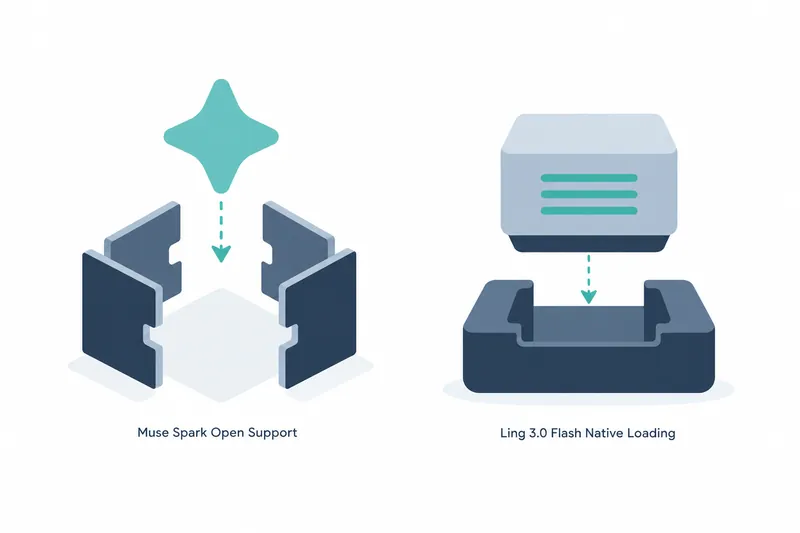
Meta's Muse Spark Open accepts four input types and generates text. It was trained for coding tasks such as editing multiple files, debugging, and tool calling. For example, it can handle tasks combining code with screenshots or screen recordings.
InclusionAI's Ling 3.0 Flash is a mixture-of-experts language model that selects some computational networks for each input segment. The key change is loading through a built-in implementation without enabling trust in external repository code.
2. Check Ling's loading and optimization separately
The documented model class is BailingHybridForCausalLM. The usage example loads a saved model with AutoModelForCausalLM, prepares conversational input, and generates a response.
Some internal model computations include fallback implementations that run using only PyTorch. These allow the computations to run without separate optimization packages.
Installing flash-linear-attention and causal-conv1d automatically enables optimized computation code in CUDA environments for NVIDIA GPUs. This is an optional optimization path, not a prerequisite for loading the model.
3. Muse also unifies input preparation
MuseSparkProcessor combines text tokenization, image, video, and audio preprocessing, and conversation formatting. Developers can prepare different input types as a conversation and pass them to the model.
The context window, the input range the model can handle at once, is up to 1,048,576 tokens. Tokens from images, video, and audio share this range with text, so it should not be treated as capacity reserved for text alone.
According to the blog, video sampling defaults to 2 frames per second, with a maximum of 96 frames. Keeping more frames can preserve more information between events, but increases memory use and input processing time before response generation.
4. Less computation does not mean low memory requirements
Muse selects 8 of 256 experts in each layer, activating 42 billion of its total 816 billion parameters per token. Parameters are the model's numerical values determined through training.
This architecture saves computation by running only some networks, but deployment memory must accommodate the full model. The blog puts BF16 weight files at about 1.5TB. Unified input handling does not remove the hardware burden of hosting a large model.
The cache storing computation results from previous inputs also needs separate consideration. The blog's BF16 estimate is about 250KB per token, or about 266GB at maximum context. This is a separate cost from the weight files.
5. Check low-precision weights and parallel execution separately
NVFP4 stores weights at lower precision to reduce memory requirements. However, the model development documentation requires compatible hardware and a separate installation branch. Its installation example is:
pip install git+https://github.com/huggingface/transformers.git@finegrained-per-scheme-demoThe release notes warn of slowdowns in expert-parallel inference, which distributes experts across devices. Neither the extent nor the measurement conditions are given. Deployments using this path should check latency on actual workloads.
This support offers unified input handling and model loading, while adoption decisions should assess feature support separately from actual deployment resources.