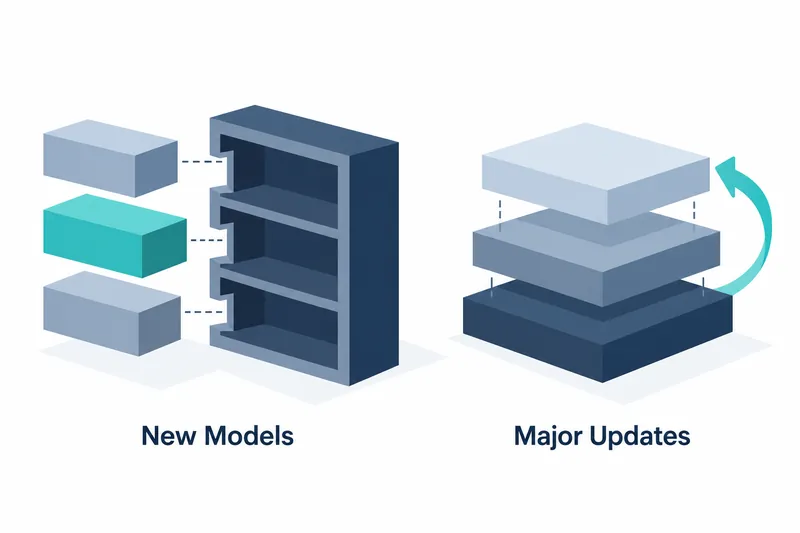
SGLang, a tool for running AI models on servers, has expanded model support and changed defaults for caches that reuse repeated input and for request handling. Development teams evaluating model deployments have more options. But upgrades to existing services require checks of both installation paths and compatibility.
1. New models and server role switching
The release notes list DeepSeek-V4.1 Flash and GigaChat 3.5 as new models. This expands support so teams can evaluate new models within their existing server tooling.
DiffusionGemma and Qwen-Image 2.1 are among the additions to the diffusion model list. The expanded support covers diffusion models as well as language and vision-language models.
Servers can now switch roles between input preparation and answer generation without restarting. Environments that operate these stages separately can change server roles at runtime.
A Score API has also been added to score candidates in a single request. Separately, the Decisions API uses language and vision-language models as low-latency classifiers and scorers. This extends server usage beyond response generation to judgment tasks.
2. Differences between support lists and installation guidance
The release notes provide the following upgrade command.
uv pip install --prerelease=allow sglang==0.5.21However, the model deployment guide still says support for the model is not yet included in a release. It points to the NVIDIA preview image lmsysorg/sglang:dev-dsv41. This conflicts with the release notes announcing new support. No evidence is provided to conclude that this command alone guarantees model deployment.
The deployment guide is organized around validated combinations for specific hardware and use cases. It distinguishes setups for fast single-user responses from those for higher total throughput across multiple users. Teams should check the container image for their chosen configuration, not just the model name.
3. Separating reasoning and handling tool calls
Separating model-generated reasoning from the final answer requires enabling a parser that interprets it. The parser separates content already generated; it does not switch reasoning on. Reasoning is off by default and turns on when a request sends a value other than none for reasoning_effort.
Tool calls also require a dedicated parser. This model's tool-call tags contain spaces, which existing detectors cannot interpret. If tags appear in the response body instead of structured calls, the parser settings are a place to start checking.
4. The costs of faster responses and freeing memory
DSpark is a drafting feature built into the model. It accelerates interactive tasks by predicting and verifying answer fragments. But its high per-run cost means speed does not scale in proportion to draft length. The guide notes different acceptance rates for math and code versus open-ended conversation. It also says the feature is disabled in high-throughput configurations that process large batches.
Optional memory table offloading moves tables from GPU to host memory, freeing space for the KV cache that holds previous computation results. According to the guide, this move itself does not change output bits. However, it increases host memory use and loading time, and efficient data gathering requires large memory pages.
An optional prefix cache eviction policy also has conditional improvement figures. A test replayed agent task histories with concurrency set to 32, using a 4-bit DeepSeek-V4-Pro configuration and 4 B300 GPUs. The 99th percentile of inter-token latency fell by 43.9%. This marks the boundary of the slowest 1% of response intervals, not a general speedup rate for the new model.
5. Defaults existing services should check
The prefix cache, which reuses computation for repeated input prefixes, now uses a Rust core by default. Unsupported configurations automatically fall back to Python. This changes the default cache implementation for reusing results when requests share a prefix; it does not replace the entire server.
Requests that include the chat template itself are now rejected by default. A server-side trust option must be enabled to allow them; other template arguments remain unchanged. Clients that previously sent a template with every request should include this behavior in upgrade tests.
FlashInfer's mixture-of-experts post-processing is now disabled by default for numerical accuracy. The trade-off is some added latency for operations using 4-bit weights and 4-bit activations. A default change made for accuracy should not be judged solely as a performance regression.
This version expands model choices while changing operational defaults, so it is worth testing new models separately from compatibility checks for existing requests.