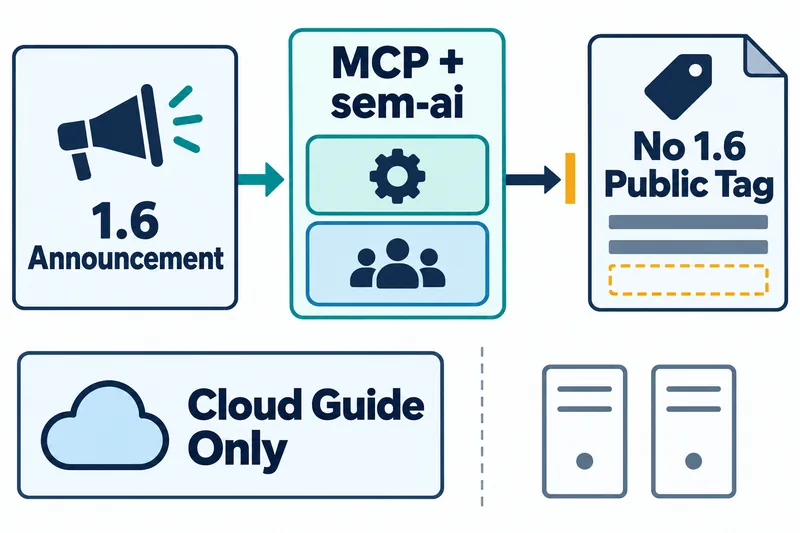
Semaphore announced on October 9 that Open Source 1.6 includes an MCP server in Community Edition (CE) and Enterprise Edition (EE). It broadens the integration point for AI agents across both editions, allowing them to read information from continuous integration (CI), the build and test automation system, and request jobs.
MCP is a standard protocol for connecting AI agents to external tools. sem-ai is a command-line tool (CLI) built so agents can operate Semaphore CI jobs. Semaphore said 1.6 supports the tool without additional configuration and that both service accounts and user tokens can be used.
MCP server inclusion and a planned RC in version 1.6
For self-hosted operators, the first question is not whether the feature exists, but where an installable artifact is located. The announcement says the MCP server is “now included,” while also stating that a release candidate (RC) with the detailed change list will be ready in a few days.
Neither a final 1.6 release nor an RC entry appeared among the six GitHub releases and ten tags checked on October 15, 2026. The most recent release found was v1.5.0, published on October 10, 2025.
This means the artifact was not found in the public listings checked; it is not evidence that 1.6 does not exist through another path. Still, the announcement alone is insufficient to conclude that 1.6 can be downloaded and upgraded to now.
Separate connection paths for cloud MCP and sem-ai
The official MCP setup documentation reviewed is labeled “Cloud (SaaS).” It gives the cloud endpoint and authentication method, and says the support team can activate an organization's MCP feature at no additional cost on request.
The `workflow_run` and `workflow_rerun` operations used to execute and rerun jobs require MCP write permissions to be enabled separately. In the cloud, the authorization conditions for reading information and requesting execution are also distinct.
Meanwhile, the sem-ai README documents `sem-ai mcp`, the command for running the separately installable sem-ai MCP server. This differs from the official remote MCP connection to the cloud, and the two paths cannot be treated as the same server or artifact.
Therefore, these documents alone do not reveal the MCP endpoint or the authentication and activation procedure for CE and EE 1.6. The announcement of “sem-ai support without additional configuration” also does not establish that the sem-ai executable is included in the CE and EE artifacts.
Operational conditions for RustFS and partial reruns
The same announcement says the storage engine for build artifacts changes from MinIO to RustFS and that tests use RustFS. It also presents partial reruns, which rerun selected jobs without rerunning an entire long-running pipeline.
However, the announcement provides no existing-data migration procedure, no statement of configuration compatibility, and no rollback procedure if problems occur. It leaves the rules for selecting jobs and handling dependencies in partial reruns unexplained and does not state the availability scope for either change in CE and EE.
With a storage-engine replacement, what matters is whether existing artifacts remain readable; with partial reruns, the benefit depends on which jobs run again. The announcement alone does not make it possible to judge the safety of the change or the actual reduction in work.
All of this material comes from vendor-owned primary sources; it does not include installation or runtime verification, or any independent performance measurement. The current evidence shows the direction of broader agent integration, but it is insufficient to support direct application in an operating environment.
Verifying public artifacts and edition-specific deployment procedures
An upgrade assessment starts with checking the official release and tag listings for the 1.6 artifact and its detailed change list. The documentation for the edition in use is then the place to check the installation method and the MCP connection, authentication, permission and activation procedures.
Copying the endpoint from the cloud documentation into the CE configuration cannot substitute for that check. The evidence to examine is not only the expanded feature list, but also the artifacts and documentation that state the conditions for applying those features in a self-hosted environment.
Semaphore 1.6 is an announcement of broader agent integration for CE and EE, while an actual upgrade decision still requires checking the release artifacts and the self-hosted deployment procedure.