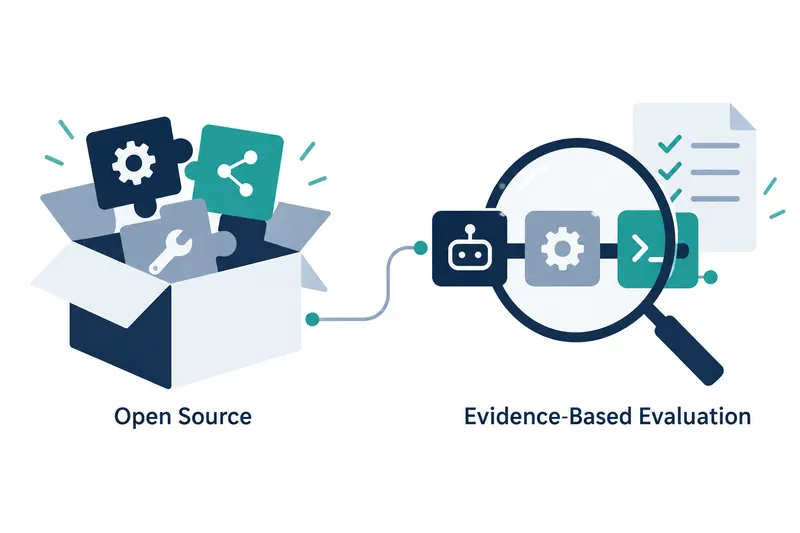
Qoder has open-sourced Better Harness, a toolkit that bundles development features to analyze coding agents' work using evidence. Developers can review what an agent did and how it checked the results. Instead of vague scores, they receive problems to fix and ways to verify those fixes.
1. Guidelines, an evaluation model, and execution tools released together
Better Harness analyzes and improves how coding agents work. According to Qoder, available work records and report formats varied by the program hosting the agent. At release, the Qoder integration was the most complete reference implementation: example code demonstrating the features.
The release has three layers: issue-specific engineering guidelines, the Agent Work Loop evaluation model, and executable code for analyzing real projects. The repository includes not just guidelines but an implementation for gathering evidence and repeating assessments. It is distributed under the MIT license, which permits modification and redistribution.
According to the company, 100,000 people tried the feature in its first three days in Qoder Desktop, before the public release. The release extends an evaluation framework first used in the desktop product to other coding agents.
2. Evaluating use in tasks, not just the presence of settings
The evaluation unit is a task with one goal and completion criteria. A session is an execution unit containing a continuous work record and evidence of the process. Rather than merely checking whether tests exist, the tool examines whether the tests the agent ran actually checked the changes and key risks.
The model has five dimensions and fifteen checks: task understanding, execution control, change verification, reliable delivery, and accumulated learning. It records whether components exist, are linked to the task path, have actual execution results, or are supported by later comparisons. It also distinguishes what could not be verified from what was actually absent.
For the first four dimensions of the current task, the model document sets score ceilings based on evidence strength: how complete the evaluation evidence is. Stronger evidence permits higher scores, but a dimension cannot exceed 59 if a required check remains unresolved or blocked. For accumulated learning, the agent separately selects an integer in the range 35~100.
Table: Score ceilings for the first four dimensions by evidence level
Conditions: Based on the repository's Agent Work Loop model. Applies to the first four dimensions; accumulated learning follows separate rules.
Unit: points
| Evidence level | Score ceiling |
|---|---|
| Absent / not observed / not applicable | 59 |
| Present | 74 |
| Linked | 84 |
| Executed | 94 |
| Supported by later outcomes | 100 |
3. Reports identify problems to fix and ways to verify fixes
The analysis examines what the agent did in the session, how the project supports execution, diagnosis, and verification, and evidence of agent asset configuration and use. Agent assets are the settings and tools the agent uses. It then combines these findings against the evaluation model. Alongside scores, reports offer prioritized improvements, each with impact, evidence, scope of changes, and verification steps.
The repository includes a saved example report from analyzing the Better Harness project itself with Codex. The analysis covered one observed session without editing or delivery. Its scores across the five dimensions are shown below.
Table: Dimension scores in the repository's example report
Conditions: One fixed Codex self-analysis example in the repository. Analysis of one observed session, without editing or delivery.
Unit: points
| Dimension | Score |
|---|---|
| Task understanding | 78 |
| Execution control | 56 |
| Change verification | 72 |
| Reliable delivery | 48 |
| Accumulated learning | 35 |
The example's overall task effectiveness score is 58, and its asset status/change progress score is 0. The report notes that delivery procedures are described, but evidence for accepting the current results and a path to restore the installation state are lacking. The format shows which procedures need improvement alongside the scores.
4. Install and run it for your host, the program environment running the tool
Claude Code and Codex were supported at release, with installation methods differing by program. The public documentation gives the following example for registering the repository in Claude Code and installing the plugin, an add-on that provides features.
/plugin marketplace add QoderAI/better-harness
/plugin install better-harness@better-harness
After installation in Claude Code, open a new session in the project to analyze and run /better-harness.
It is built into Qoder Desktop without a separate installation. Users can also select the beta, a pre-release trial feature option, on the Quest screen.
At release, Cursor was supported by loading the source.
Qoder CLI and the JetBrains plugin were also described as available in environments with the desktop app installed.
5. Evidence still requires review and adjustment
The tool's practical benefit lies less in scores than in making judgments reviewable. Each improvement links observed evidence, a minimal scope of changes, and verification steps. This helps teams fix issues one at a time and check for changes in later tasks of the same kind. However, users must learn host-specific installation and output methods, read the evidence, and verify proposed fixes.
The example report is only one case included in the repository, not evidence of long-term improvement. Qoder also says the model was built around familiar projects and task types, so it may miss issues in other technical environments or team settings.
The public documentation suggests starting with one issue whose evidence and impact are clear. Fix and verify it, then observe a similar task to check whether the change also helped with the next task.
Better Harness is not just about scoring agents, but about connecting evidence observed in their work to the next improvement.