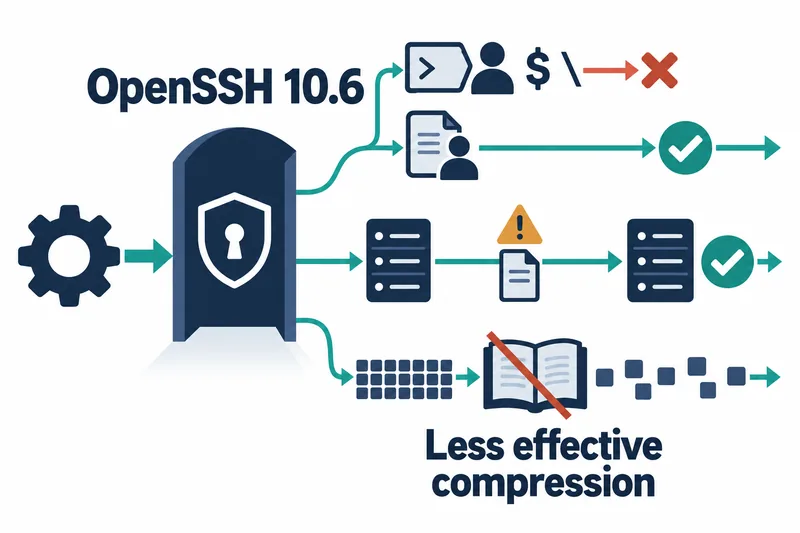
OpenSSH introduced command-line username restrictions and compression changes in 10.6 and its portable release, 10.6p1, released on October 6, 2026. The official release notes also announced the deprecation of scp -R, but this release does not disable that copy functionality.
The same username may be rejected depending on how it is supplied
Automation that passes destination usernames on the command line may now see previously accepted input rejected. ssh now rejects command-line usernames containing a backslash (\) or dollar sign ($).
Names specified through the User directive in a configuration file are exempt. Interpreting this as a ban on those characters across all configuration paths would therefore misstate its scope.
The change addresses command injection risks when untrusted usernames enter shell commands through features such as ProxyCommand or Match exec. The exemption for the User directive does not guarantee that every way of handling usernames in a shell is safe.
scp -R gets a warning; LZ77 compression is disabled
scp -R runs scp on a remote host to copy files between remote hosts. It continues to work in 10.6 but prints a deprecation warning to standard error.
A future release will ignore this option and use the default path through the client host that initiated the copy. No date has been set for that change.
OpenSSH cites the need for authentication credentials on the remote host and inconsistencies in shell quoting. Adding the warning now and changing the data transfer path later are separate steps.
The compression change takes effect in this release. ssh and sshd disable the LZ77 dictionary coder, which compresses data by finding repeated content.
The release notes describe a problem with channels—multiple logical communication paths within one SSH connection—sharing a compression dictionary. An attacker could insert chosen content into one channel and observe changes in encrypted transmission lengths to infer secrets in another. OpenSSH says this mitigation reduces compression effectiveness and recommends application-level compression where possible, but provides no measured changes in throughput or CPU usage.
Forwarding restrictions also apply on some platforms: those without file descriptor passing, which transfers references to open files between processes, and where allocating a pseudoterminal (PTY) requires root privileges.
Under these conditions, sshd-session retains root privileges after authentication and can bypass controls that apply to the logged-in user. GatewayPorts and StreamLocalForwarding, options related to port and local socket forwarding, are therefore forcibly disabled.
The release notes list QNX 6, SCO OpenServer 5, and builds previously made with --disable-fd-passing among those affected. However, that build configuration option itself was also removed in 10.6. The restriction does not apply to every server, and there is no firm schedule for dropping support for these platforms if no alternative is found.
These changes are described in the official release notes, not established through a reproduced upgrade or performance test. Reduced compression effectiveness alone does not establish that every workload will have lower throughput or higher CPU usage.
OpenSSH already advised against compression on connections that mix trusted and untrusted traffic. Applying the described attack conditions to every compressed session would also overstate their scope.
Distribution-specific package availability and patch status need separate verification. This announcement alone does not establish a universal upgrade deadline or the impact on production environments.
Automation inputs and paths to check before upgrading
The review can focus on features the automation actually uses. Checking whether generated destination usernames contain $ or \ and whether they are passed on the command line can identify exposure to the new input restriction.
For copy jobs, relevant checks include whether scp -R is used and how warnings on standard error are handled. Automation that treats warnings as failures could be affected even though copying still works.
Workloads that rely on SSH compression warrant testing with their actual data and connection conditions. For affected older servers, relevant checks include both file descriptor passing support in the build and the privileges required for PTY allocation.
These are suggested checks for identifying the scope of the changes, not experiments performed or output observed.
The next developments to watch are when the scp -R warning becomes an actual copy-path change and how the compression change affects individual workloads. For now, input paths and features in use provide a sounder basis for review than questioning SSH compatibility as a whole.
Reviewing automation for OpenSSH 10.6 starts with distinguishing the username and compression changes already in effect from the scp -R copy-path change that remains at the warning stage.