A new build for developers testing large language models on consumer GPUs adds a speed-boosting predictive aid to a compressed model with fewer refusals. It also uses more memory, so choose based on GPU capacity and text length.
1. Uncensoring and acceleration are separate
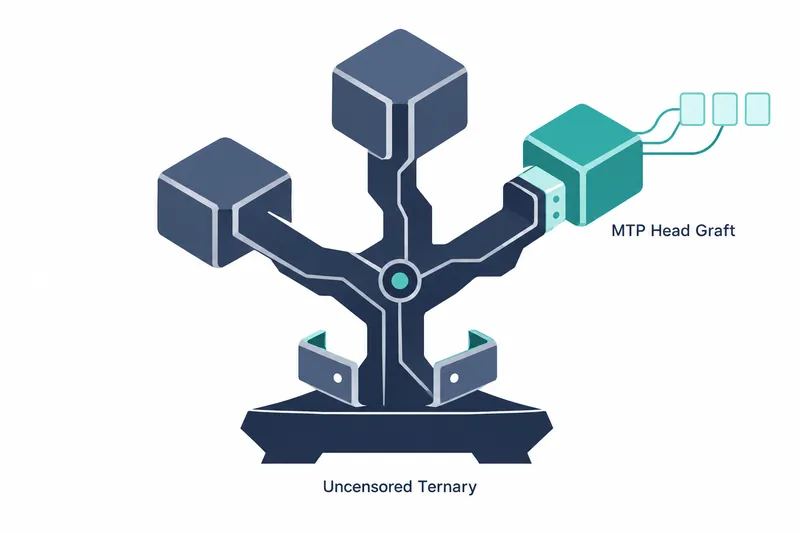
The base is OS-Software's uncensored Ternary Bonsai 2 27B build, with a multi-token prediction head transplanted from Qwen 3.8 27B. The base creator handled uncensoring. This distributor added the head, integrated files, tools and core compute code. This is not an official release from the original developer.
Ternary compression reduces storage by representing weights with three values.
Multi-token prediction speeds generation by having an auxiliary component draft ahead and the main model verify it, using accepted drafts. The distributor says the base weights are unchanged, with 15 prediction tensors adding 335 MiB.
2. A dedicated runtime and configuration are required
Standard llama.cpp cannot read this file's compression format. Benchmarks used the bonsai2 branch, a modified PrismML-family runtime that includes the required prediction-head changes. Below is the model card's example for a 12GB GPU.
hf download sudoingx/Offrail-27B-Uncensored Offrail-27B-12G.gguf --local-dir .
GGML_CUDA_BATCH_INVARIANT=1 llama-server -m Offrail-27B-12G.gguf \
  -ngl 99 -fa on -c 131072 -np 1 -ctk q4_0 -ctv q4_0 --jinja \
  --reasoning-effort medium --spec-type draft-mtp --spec-draft-n-max 1
The card recommends medium reasoning effort, as in the example. It says the default highest setting failed to return answers on three build tasks on an RTX 3060 with a 4,096-token response limit.
3. About 20% faster under the same conditions
The distributor tested on an RTX 3060 12GB with one processing slot, thinking mode off, a q4_0 key-value cache and attention acceleration on. The cache stores previously processed content for reuse. A setting to reduce batch-dependent computation differences was enabled. Each of 3 prompts was run 3 times, taking the median for 400-token generation.
With a 131,072-token context window—the amount handled at once—and a maximum draft of 1 token, the 12GB file ran at 41.4 tokens per second with the head off and 50.8 with it on. Under the same conditions, the 8GB file rose from 41.4 to 49.6. These are gains of about 23% and 20%, respectively. The 8GB file's gains varied sharply by task: 32% for code and 6% for prose. The distributor attributes weak prose drafts to a head trained on high-precision model states reading a ternary-compressed base.
4. Speed comes at a cost in memory and context length
For the 12GB file under those conditions, enabling the head raised GPU memory use after loading from 8,734 MiB to 10,618 MiB. The 8GB file saves 682 MiB by omitting a copy of the prediction component's token embeddings, the table that converts tokens to numbers. File names do not guarantee a fit at long context lengths.
The actual guidance for an 8GB GPU uses Offrail-27B-8G.gguf with a 49,152-token context window, a microbatch of 256—the amount computed together—and a maximum draft of 2 tokens. Memory use after loading is 7,732 MiB. If the same GPU also drives a display, a 32,768-token context window is recommended, using 7,300 MiB. No speed figure was provided for the latter setup.
5. Distinguish output identity from safety
With the example's batch-invariance setting enabled, both files produced byte-identical output with the head on and off. Tests used temperature 0, 1 top candidate, 300 tokens and 3 prompts. Disabling the setting can change outputs due to computation order, and on RTX 20-series GPUs it does not cover all computation paths. This does not establish quality parity with the original model.
The reported drop in refusals from 95 to 0 out of 100 questions comes from a small test by the base creator. No refusal baseline, image-input tests, context-depth performance or concurrent-execution validation was provided for this build itself.
The base creator warns of harmful or inaccurate outputs, limits intended use to research and experimentation, and advises against deployment in public or end-user services.
Choose this build not for the uncensored label, but for whether its task-specific speed gains justify the extra memory.