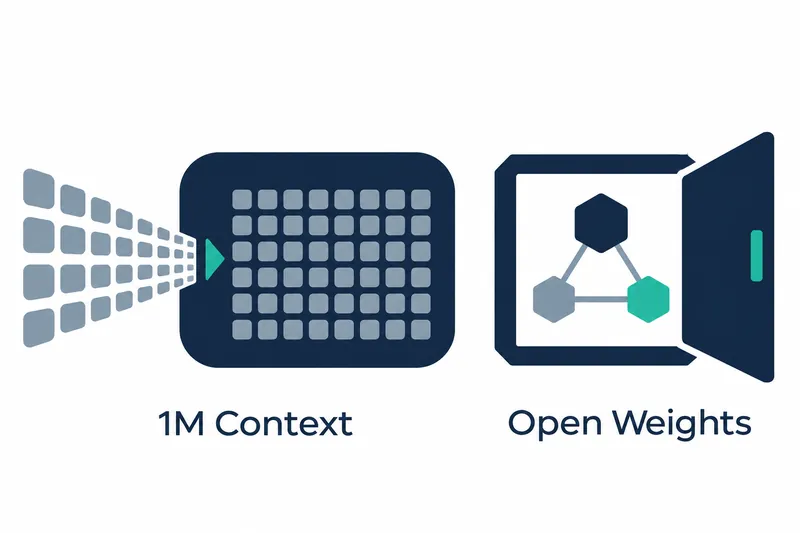
Moonshot AI has unveiled Kimi K3.1 Pro for development teams handling long documents and large codebases. With a 1 million-token context and downloadable model weights, teams can use the API or deploy it on their own infrastructure.
1. A 1 million-token context for handling long materials at once
Kimi K3.1 Pro is the first model in a new series based on Kimi K3, with expanded post-training, a stage of further training an existing model. The company says it jointly trained across hundreds of task domains using reinforcement learning, which improves performance through rewards. It also says it improved the infrastructure supporting training and response computation.
According to the model card, the exact context length is 1,048,576 tokens, and it accepts text and images. The model has 2.8 trillion learned parameters in total, but activates 104 billion per input token. This means it selects only part of the large model for computation.
The company says it processes long contexts more efficiently by replacing some layers that compute relationships across the entire input with a method that selects the necessary relationships.
The public repository contains the weights split across 96 files.
2. Reported results in coding and financial document evaluations
The company reports a Terminal-Bench 4.0 score of 65.7% on real terminal tasks. It used Claude Code as the evaluation harness at the maximum reasoning setting. Sampling settings for selecting output candidates were the same as in the financial document evaluation below.
In an internal long-horizon coding evaluation covering multistep execution and tool use, it scored 61.2%, above the previous model's 55.95%.
The company reports a BenchCAD score of 92.7% with tools for reconstructing 3D shapes from images taken from multiple directions. This result used 1,000 cases randomly selected from 17,900, evaluated with Claude Code at the maximum reasoning setting.
The company reported the results below on OfficeQA Pro v2, which analyzes financial documents. All three models processed the full PDF materials as page images and were evaluated with Claude Code. The table includes only public models evaluated under these shared conditions.
Table: Public model results in the financial document analysis evaluation
Conditions: OfficeQA Pro v2, full PDFs supplied as images with no machine-readable text, Claude Code, maximum reasoning setting. Kimi sampling settings: temperature = 1.0, top-p = 0.95
Unit: Evaluation score
| Model | Score |
|---|---|
| Kimi K3.1 Pro | 64.4 |
| DeepSeek-V4.1-Flash-1017 | 40.4 |
| GLM-5.3 | 31.1 |
With the same document input method and evaluation tool, Kimi scored 24.0 points above DeepSeek-V4.1-Flash-1017 and 33.3 points above GLM-5.3. The evaluation covers cross-document comparisons and multistep numerical reasoning. It thus shows not only the ability to accept long materials, but also practical usefulness in finding evidence and completing answers.
According to the company announcement, its internal financial modeling evaluation, testing formula links and financial logic, improved by 7.2 points over the previous model. Its financial research evaluation, testing whether research has auditable evidence, improved by 11.6 points.
The company says the claim-level hallucination rate in its internal factuality evaluation fell from 23.4% to 8.3%. This is the proportion of individual factual claims in responses that are incorrect. The hallucination rate comes from a stress test of error-prone cases, not the overall error rate in everyday use.
3. Use the API or deploy on your own servers
According to the blog's access guide, it is available on the web and mobile apps. The Kimi Work desktop app for work requires version 3.1.0 or later.
In Kimi Code, select the model with the /model command.
The Kimi API supports OpenAI- and Anthropic-compatible formats. API customers can also choose zero data retention.
For self-hosting, the company recommends inference engines such as vLLM and SGLang, which compute model responses. The Hugging Face page provides this vLLM installation and launch example:
# Install vLLM from pip:
pip install vllm
# Start the vLLM server:
vllm serve "moonshotai/Kimi-K3.1-Pro"
For multi-turn conversations or tool calls, pass the entire assistant message returned by the API unchanged into the next request. The model card requires preserving reasoning content and tool-call history as well.
4. Operational control brings added responsibilities
A long context can reduce the work of splitting materials into small pieces, while open weights let organizations run, modify, and redistribute the model themselves. In return, the infrastructure burden of storing and running inference on a 2.8 trillion-parameter model shifts to the organization operating it.
The license permits modification and commercial use. A model service here gives third parties substantial control over inputs, parameters, or training data. If a user or its affiliates operate such a service and their combined revenue exceeds $20 million over 12 consecutive months, a separate agreement is required before commercial use. End products embedding the model only for specific functions and services merely relaying requests to third-party-hosted models are excluded from this definition of a model service.
A display requirement requires prominent display of the model name. It applies if a commercial product or service exceeds 100 million monthly active users or $20 million in monthly revenue. The separate agreement and name display conditions do not apply to internal use or use through official products and authorized inference partners.
Kimi K3.1 Pro combines the ability to handle long materials with operational control, broadening development teams' choices from using a service to deploying it themselves.