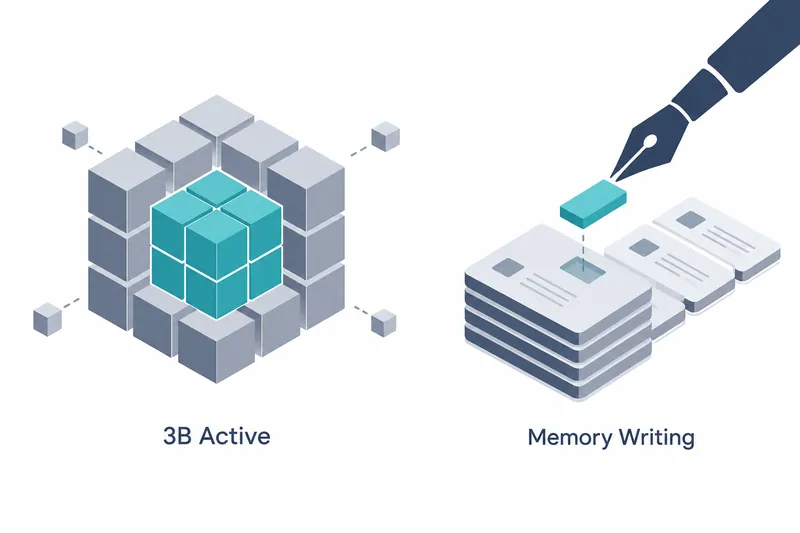
Tencent Hunyuan has released a dedicated model that selects information from conversations or task histories for long-term storage. Developers building long-term memory features can keep their existing memory management systems while replacing the general-purpose language model responsible for writing records.
1. It writes memories rather than answers
Released on October 15, Hy-Memory-30B-A3B is a mixture-of-experts model with 30 billion total parameters, activating about 3 billion per computation. Its architecture selects a subset of experts, and its weights are licensed under Apache-2.0.
Long-term memory systems record information, retrieve relevant records, then read them to answer questions. This model handles the first step: deciding what to retain, how much detail to include, and how new information should update existing records. It addresses the problem that retrieval alone cannot recover facts omitted from records.
Training has two stages: teacher-model guidance based on records the model writes, followed by reinforcement learning that evaluates whether stored information supports later answers. The latter rewards links between evidence used in answers and the original input spans. It penalizes unnecessary storage and excessive record growth.
2. It replaces the writing model in existing services
It was trained to replace the general-purpose models in Mem0 and MemOS. Its own framework covers conversations, work, and coding. It does not also replace the retriever or answering model.
The model card provides deployment instructions verified with vLLM 0.31.0, using an OpenAI-compatible API. The framework requires a language model endpoint and an embedding endpoint that converts text into numerical vectors for retrieval.
Below is the repository's original configuration example. It is a generic example pointing to another provider's model. To connect the released model directly, change the language model URL and model name to match the deployed service.
export MEMORY_LLM_API_KEY="sk-your-key"
export MEMORY_LLM_BASE_URL="https://api.deepseek.com"
export MEMORY_LLM_MODEL="deepseek-chat"

export MEMORY_EMBEDDER_API_KEY="sk-your-key"
export MEMORY_EMBEDDER_BASE_URL="https://dashscope.aliyuncs.com/compatible-mode/v1"
export MEMORY_EMBEDDER_MODEL="text-embedding-v3"
export MEMORY_EMBEDDING_DIMS=1024
3. Scores reflect changes to the writing model alone
The paper held versions, prompts, retrieval settings, answering models, and grading models fixed across four memory frameworks. Each writing model built records from an empty store, using a fixed 20% sample from each benchmark for evaluation. Each framework's score is an equally weighted average of six metrics. The overall score is an equally weighted average of the four framework scores.
Under these conditions, the released model scored 55.49% overall, above Claude Opus 5 at 54.62%. However, a higher average does not mean it led on every individual evaluation item.
On EverMemOS, which was excluded from training, it scored 56.89, exceeding DeepSeek V4.1 Flash at 55.47. This suggests its writing ability may transfer beyond the systems used in training.
4. Distinguish computational benefits from operational burdens
The expected benefit is assigning record writing to a dedicated model with few active parameters. Retrieval and answering are still necessary, however, and self-hosting also requires operating the writing model service. With 30 billion total parameters, storage and memory requirements should not be judged by the active parameter count alone. No actual latency figures or operating cost savings were provided.
5. Look at validation scope rather than small margins
For the two frameworks used in training, the paper interprets the 0.01–0.02-point gaps against Claude Opus 5 as parity, not statistically distinguishable superiority. Only one framework was excluded from training, and validation through repeated training remains future work.
The reward links retrieved evidence to input spans, but does not prove that a particular record caused an answer to improve. No controlled experiments removing individual reward components were provided either. This makes it difficult to establish which training mechanisms drove the improvements.
This release matters more as specialization of the writing stage than as a replacement for an entire memory system, so adoption should focus on record quality in real work rather than small average score gaps.