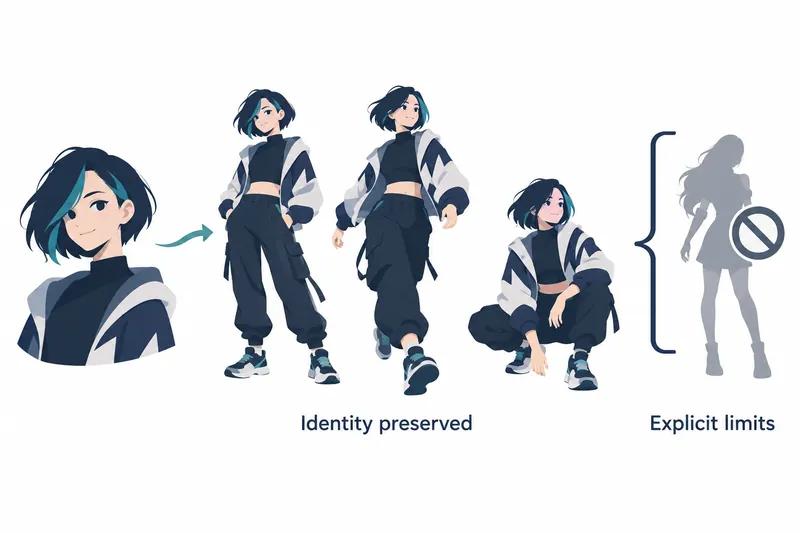
A new model is recommended for creators replacing a person in a video with a reference character, keeping the changed face and hair longer. Does this improvement justify its memory demands in actual editing shots?
1. The new default and evidence of improvement
H3 Character Swap LoRA V1.5 is an auxiliary set of weights added to MiniMax H3 to guide character replacement. It adjusts the existing video model toward that task rather than replacing it as a complete product.
In model card comparisons, V1.5 retains the character longer where V1 loses the reference appearance or reverts to the original person. These are selected improvements, not aggregate tests or guarantees for every shot.
The existing front-page demo and examples show results from the previous version, not demonstrations of the new version.
The model card's training and provenance notes distinguish internal naming and budget from completed work. Internally named V2, it had a 2,250-update budget, but saved steps and the final termination log confirm 1,000 additional updates.
2. Installation and input preparation
Users must separately obtain the base video model, a component that converts text into model inputs, and components that compress and reconstruct video and audio. The adapter cannot run alone.
The H3 Relay 2.0 workflow exposes masks marking the person to replace and sampling, the stepwise video generation process, as on-screen nodes. This workflow update did not change the model weights.
The repository provides this manual installation example.
cd /path/to/ComfyUI/custom_nodes
git clone https://github.com/akatz-ai/h3-relay.git
This workflow requires ComfyUI 0.37.0 or later. After installation, restart the application and prepare the separate model files and video input/output tools.
Supply the source video as the motion reference in <Video 1> and the reference image for face, hair, and clothing in <Picture 1>. Describe the person to replace and the reference character, and check that the mask tracks that person. Start with a short, continuous shot at 24 frames per second, review the result, then increase the length.
3. Reproducibility checks are not quality rankings
The validated setup uses the Ref2VA INT8 base model, which stores weights as 8-bit integers, with the character and separate Turbo adapters each set to strength 1.0. The Turbo adapter adds auxiliary weights for low-step generation.
Sampling uses 8 steps, with guidance strength, the degree to which instructions influence the result, set to 1. The sampler, the update method during generation, is er_sde; the scheduler, the step progression plan, is normal.
The relay release candidate GPU validation ran on an RTX 4090 under Linux. Each old/new workflow pair matched video, reference image, mask, prompt, random seed, model hash identifying the model files, and sampling settings.
For a single segment, the new workflows for V1.5 and V1 each matched their respective old workflows pixel-for-pixel across all 120 frames. This does not mean the two models produced identical results.
In a two-segment character swap, only 22 of 43 frames matched, with a mean absolute difference of 1.482121 on a 0–255 scale. Small differences remained in faces, poses, and backgrounds, so numerical equivalence was not claimed. This checked reproducibility during workflow migration, not relative model quality.
4. The boundaries of benefits and costs
The expected benefit is longer retention of the reference person's appearance, but memory demands remain. In the GPU validation log, keeping the full model resident exhausted memory on a 24GB graphics card. With the same generation settings, standard offloading of some components to main memory completed the run.
The output is not produced by cutting out only the masked region and pasting it onto the original. Review must therefore cover nearby people and backgrounds, not just the replaced person. Check appearance, original timing, expressions, occlusion, and scene transitions.
5. Output and usage terms
Attaching the original soundtrack to the final video is an application feature. It must not be interpreted as evidence of accurate audio reproduction or lip synchronization by the model.
The adapter follows the MiniMax H3 Community Terms, while the relay code follows GPL-3.0. Code licensing does not grant rights to model weights, so check each model's terms separately before deployment or commercial use.
Selected appearance-retention examples justify trials, while workflow reproducibility checks only support reproducing prior results, not quality guarantees. Account for memory demands and verify improvements on short shots intended for actual editing before adopting it.
This version is a starting point for testing improved character appearance retention, not a complete editor that replaces reviewing the results.