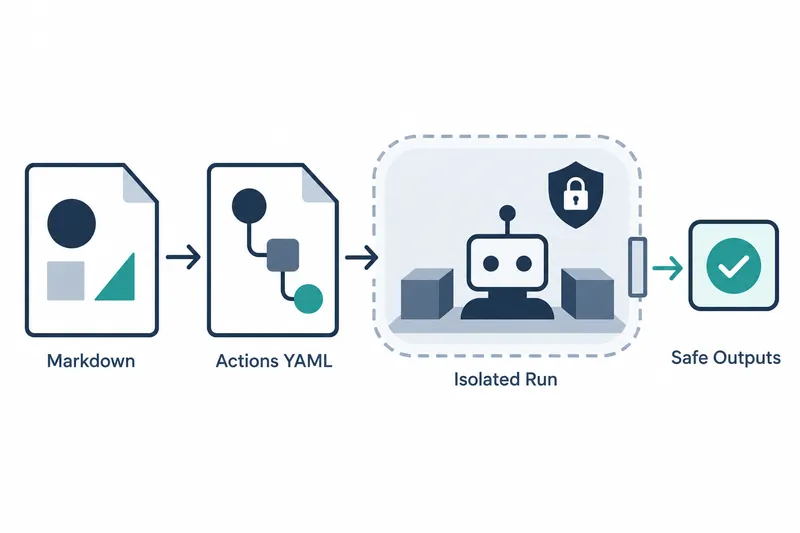
On October 28, 2026, GitHub made GitHub Agentic Workflows generally available, connecting coding agents to existing development automation. Developers can describe tasks in natural language to delegate issue triage or integration failure analysis while retaining existing execution environments and policies.
1. Actions runs rules written in Markdown
Users describe automation in natural-language Markdown files. The tool compiles these into standard Actions YAML, turning natural-language rules into execution settings.
This open-source project began at GitHub Next, and its agents run inside GitHub Actions. It reuses existing runner groups, which are groups of servers that execute jobs, and policy constraints.
GitHub lists issue triage, integration failure analysis, documentation updates, and test writing as use cases. Coding agents handle work that is difficult to address through repetitive procedures alone.
2. Safeguards separate execution from applying changes
Agents follow content access rules and run in isolated sandbox containers with read-only permissions by default, protected by a firewall. Safe-output procedures validate agent outputs. Dedicated threat-detection jobs inspect all proposed changes for risks before they are applied.
Micro VMs are also available to isolate execution at the virtual-machine level. Cross-repository workflows use enclaves, protected areas that separate data, to prevent data leaks. This structure combines execution isolation with checks before results are applied.
3. Start by choosing models and forecasting budgets
Each workflow can use GitHub Copilot or connect to a custom coding agent. The model lineup has been updated, and model providers can be selected per workflow. A model router can automatically choose a model suited to the task type and difficulty.
Budget forecasting also helps users check threat-detection credits and monthly usage ranges. The forecasting command was experimental during public preview but left that stage with general availability. The command shown in the source is below.
gh aw forecastTo get started, install the command-line extension using the quickstart guide. GitHub Next's example repository includes workflows for issue triage, dependency management, code review, and reporting. Add a new workflow template with the command below.
gh aw add-wizard4. Adopting teams reported time savings and fewer errors
GitHub featured an account from Ben Alton, a senior manager on Accenture's strategy, architecture, and innovation team. According to the company's account, one lead estimated saving about 29 hours per week on his development work. His team's measured work velocity more than doubled on average. AI reportedly authored 91% of the team's commits.
In the same quotation, Alton described workflows that carry features from requirements through implementation and validation evidence. With AI working through completion, engineers can handle 4~5 tasks in parallel and focus on larger goals. This suggests a shift from delegating individual tasks to delegating a flow spanning implementation and validation.
GitHub reported that the same team's production errors, meaning errors in live operating environments, fell from about 11,000 per day to fewer than 1,000. Using approximate figures, that is roughly a tenth of the previous level or less. The source provides no measurement period or aggregation method, making it difficult to compare the figures' baselines. These figures concern different subjects and units, so they should be read as a company account rather than combined into one performance metric.
Table: Accenture team's production errors before and after adoption
Conditions: Ben Alton's team account cited by GitHub, before and after workflow adoption
Unit: errors/day
| Stage | Production errors |
|---|---|
| Before adoption | about 11,000 |
| After adoption | fewer than 1,000 |
Chart: Change in daily production errors (comparison diagram showing numerical qualifications)
Before adoption: about 11,000 errors/day ──decrease──▶ After adoption: fewer than 1,000 errors/day5. Authoring gets easier, but model and operational choices remain
Writing rules in natural language and reusing existing execution environments and policies lowers the barrier to adopting new automation. However, using Copilot CLI as the default engine requires a Copilot license, and budgets must account for model usage. Since custom agents can also be connected, organizations still need to decide which agents to use and how to operate their execution environments.
The core of GitHub Agentic Workflows is defining judgment-based work in natural language while keeping execution and change application within existing automation policies and separate inspection procedures.