On October 26, 2026, Cline released a version that lets users select cloud task models separately from local settings and track task preparation. Users delegating development tasks to the cloud can manage model selection separately. Those using an unspecified model should check the changed defaults.
1. Select a separate model for new cloud tasks
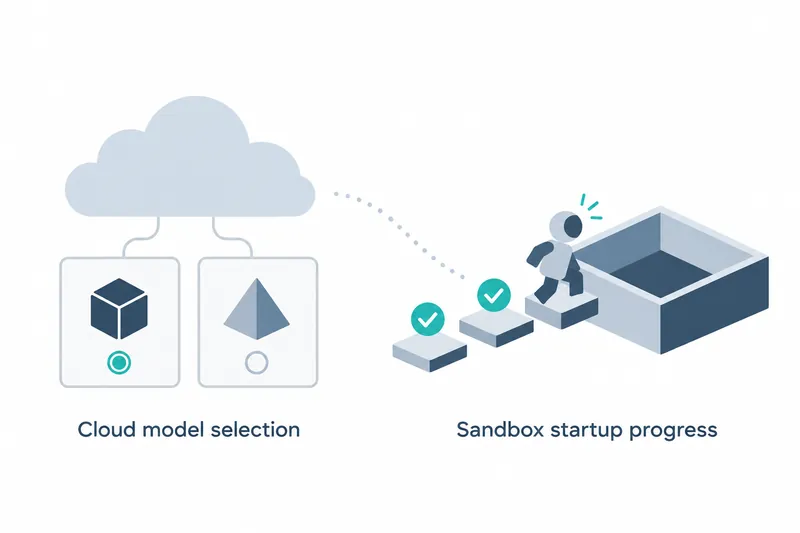
Enabling a cloud session adds local and cloud options to the API configuration settings. The model chosen here for new cloud tasks is saved separately from the local model. Users can also click the model name in the cloud session input box to open the selector and manage models by task location.
When starting or reopening a sandbox, the cloud workspace, a progress card shows the repository, the branch that isolates code changes, and preparation stages. It tracks sandbox startup, repository cloning, and startup of the agent, the AI program that performs tasks, then collapses once the agent starts. Users can follow workspace preparation on screen.
Cloud sessions hide the Plan/Act toggle for switching between planning and execution modes, along with the auto-approval bar. This interface change removes controls previously left visible but disabled.
2. Default users will also connect to different models
For users without a specified model, the Cline provider default has reverted to Claude Sonnet 5.5, which is back at the top of Cline's recommended list. The ClinePass default has changed to Kimi K3.1 Pro. Defaults have also changed for most other providers, so users without a pinned model should check their provider's selection.
The model catalog has also changed, with providers and free models both added and removed. Free options now include Reflection Beam, while Mimo V2.6 Flash has been removed. Alongside the default changes, this is another reason to check whether the model you intend to use is listed.
The model request retry limit has dropped from 5 to 3. This reduces the burden of repeating the same request but also leaves fewer chances to retry when transient errors persist. This request-handling change also applies to users with a pinned model.
3. Fixing request formats rejected by models
The GPT-6 family can now be used through OpenAI and Azure OpenAI-compatible connection paths. This follows a change to max_completion_tokens for the parameter that sets the response token limit in requests.
The same approach fixes SAP AI Core rejecting requests because of max_tokens. Both fixes align the response token limit parameter with what the model accepts.
Kimi K3 now receives max instead of xhigh, which it rejected at the high reasoning level. The reasoning level selection remains, while the actual request uses a value the model supports.
Providers using a Gemini API key no longer include Google Search in requests. According to the release notes, free-tier keys encountered 429 quota errors from exceeding per-turn request limits on Gemini 3 and later. On Gemini 2.x, all Cline tools were omitted. This fix excludes the search feature to avoid errors on that request path.
4. Fixing mismatches between input and tool execution
Switching Plan/Act during task startup no longer causes the first prompt to disappear or execution to continue with tools from the other mode. This fixes a mismatch between the selected startup mode and the tools actually used.
A fix prevents input focus from moving to the terminal when a command starts, sending chat text into the shell where commands are entered and executed. Another fix stops the next message from being treated as an answer to an earlier question after canceling a task or opening another while a question is pending.
After a user selects an option in the question tool, the model continues; empty answers are rejected.
The command execution tool now returns an error for an empty command list instead of treating it as a success. Having no commands to execute is now handled differently from success.
5. Reducing unnecessary compaction and conversation interruptions
Automatic compaction, which shortens conversation content, no longer runs when the context limit for conversation information available to the model is unknown. A fix also prevents compaction from recurring every few tool calls after an initial pass. This corrects repeated execution of the same compaction process during a task.
If the connection drops while a model is streaming only reasoning content, the turn is retried instead of ending the task. When a connection fails before an answer arrives, the flow now makes another request rather than immediately ending the conversation.
This release separates cloud model selection and fixes request and tool errors, while prompting users to check changes from their setup due to new defaults and fewer retries.