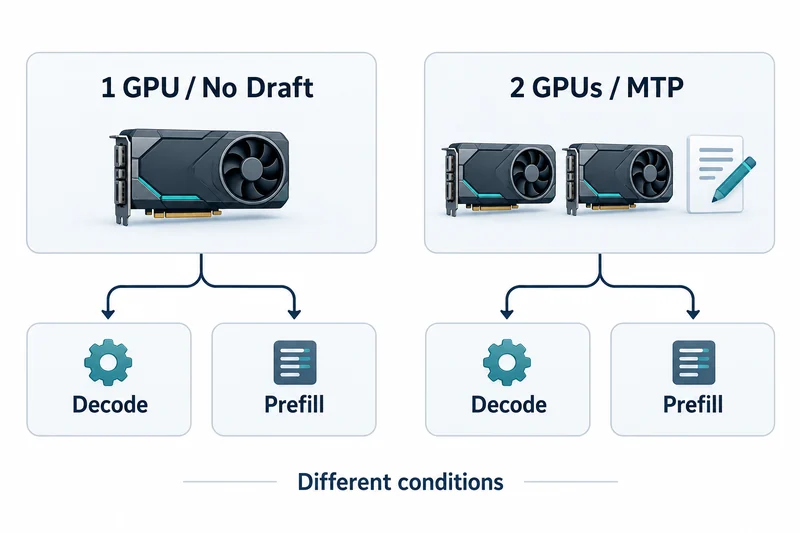
On October 12 a speed report for one- and two-card RTX 3090 setups was posted to the Project Maya repository. Contributor briepala measured mean decode (answer generation) speed at 26.0 tok/s on one card and 53.0 tok/s on two.
Both cards were power-capped at 225W. The author noted the factory limit is higher, so these are not figures for a stock 3090.
An engine that spreads experts across GPU, RAM and SSD
Project Maya is an engine built for one model, GLM-5.3-Flash. Its README says it keeps the experts a conversation uses most on the GPU, the next ones in RAM and the rest on an NVMe SSD, and moves them as you chat.
Every Maya quant keeps the original model's MTP block. MTP is a block that proposes (drafts) upcoming tokens ahead.
Measurement conditions stated in the report
The setup was Maya v1.1.2 (commit 83044ba), the Maya-S24 model, a Threadripper 3970X, 126GB of DDR4 and CachyOS Linux. Each 3090 had 24GB and a PCIe 4.0 x16 link, with no NVLink.
Decode was the mean of three 256-token answers, greedy, with thinking mode off. These are the contributor's measurements, not tests run for this article.
The one-card setup kept every layer on CUDA0 and did not draft. The two-card setup split layers 0–23 and 24–44 and drafted with the MTP block.
On one answer in the two-card run, 243 of 254 drafts (95.7%) were accepted. Prefill chunks were 32,768 on one card and 8,192 on two.
The maintainer attributed the near doubling with the second card to a higher share of experts in VRAM (65% to about 80%) and to MTP drafts.
Caveats: conditions that were not measured
Prefill on an 8K prompt was 913 tok/s on one card and 885 tok/s on two. On a 2K prompt it was 565 and 592 tok/s.
Context was set to 131,072 tokens, but the author said prompts longer than 8K, parallel requests (--parallel) and a comparison with the factory power limit were not measured.
A two-card run with the prefill chunk set to 32,768 was also on the not-measured list.
How decode and prefill affect different workloads
For work that produces many long answers, decode speed takes a large share of total time.
Work that repeatedly sends large inputs spends more time in prefill before the first token appears. In this report, prefill did not get faster with two cards.
Causes the two runs cannot separate
In the two-card setup, the share of experts in VRAM, the layer placement and MTP drafting all changed at once. Two runs alone cannot separate how much each factor contributed to speed.
So the result compares the behavior of two complete setups, not the effect of one added GPU.
What to compare again on your own system
A comparison on similar hardware can match the model pack, prompts, output length, power limit and drafting mode, and record the actual layer split and prefill chunk.
Project Maya's two-3090 report is a setup comparison in which GPU count and MTP drafting changed together, and it does not show a scaling factor for the second card alone.