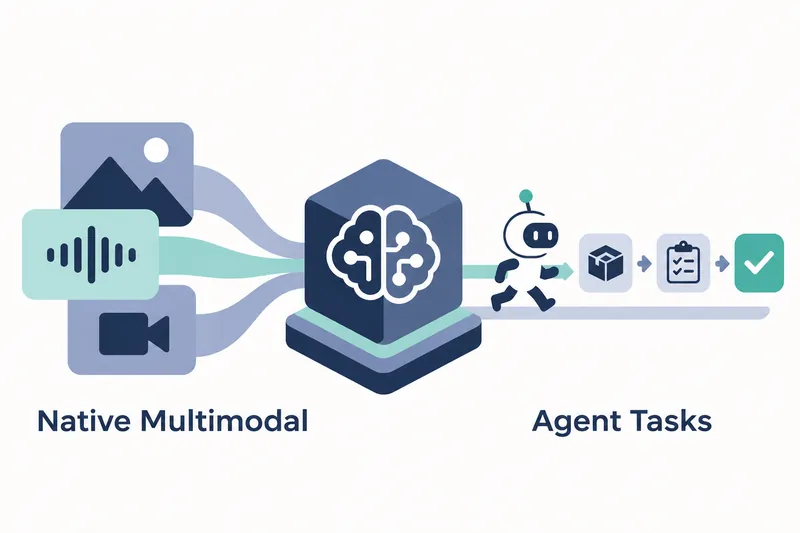
Meituan unveiled LongCat-2.5, designed to process images and text in one model and perform multistep coding tasks. Developers can try it online or via API. The focus is one model for screen understanding and long tool-based tasks.
1. Processing images and text in the same input structure
LongCat-2.5 has 1.6 trillion parameters, activating about 48 billion per token. Parameters are values adjusted during training. The company says it builds on LongCat-2.0 to improve vision and tool-based agent programming.
The model converts images into layers of codes called visual tokens, using the same input format as text. Beyond screen and image understanding, the design targets visual coding, creative design, and 3D work.
The company says it compresses images into token layers and precomputes and stores them to avoid repeated visual computation during training. Joint image-text learning was first tested on a small model averaging about 3 billion active parameters.
2. Incorporating long coding tasks into training
The company added more start-to-finish execution traces and applied large-scale reinforcement learning, rewarding outcomes through trial and error. It says this improved end-to-end work on complex repositories and project construction.
Tasks come from public repositories and real internal scenarios. Related change requests and issues inform runtime environments and tests. Execution traces and pass rates then guide task selection and test refinement during training.
Unfinished task traces are saved and resumed in the next training stage. This reduces the burden of waiting for a single long task to finish.
Separately, failed real-world agent tasks were turned into new reproducible, verifiable training tasks to address capability gaps.
Training mixes tasks and environments, with extra penalties for repetitive thinking and tool calls. Alongside sustained task execution, the company trained the model to reduce unnecessary repetition.
3. Selected results for coding and browsing tasks
Selected company-reported results are compared with the predecessor. Terminal Bench v2.1 and PaperBench evaluate coding agents, while BrowseComp and AutomationBench v1.0.6 evaluate general agents.
Terminal Bench v2.1 gained 17.6 points and PaperBench 36.9 points over the predecessor. BrowseComp and AutomationBench v1.0.6 gained 12.0 and 36.0 points, respectively. PaperBench rose from 45.2 to 82.1 points. AutomationBench v1.0.6 rose from 15.8 to 51.8 points, also substantially improving a low prior score. BrowseComp climbed from an already high 79.9 to 91.9 points. Evaluation methods differ, and comparison scores mix public data with company measurements, making a single ranking difficult to draw.
4. Training and inference infrastructure tailored to accelerator constraints
LongCat-2.5 optimizes its underlying system for long-context training and inference on Chinese AI accelerators. With under 80GB of memory per card, major communication stays within groups linked by high-speed connections. The company reports 86% higher per-card throughput than a distributed data-parallel baseline in supervised fine-tuning on long-input examples.
Inference reduces both expert weights and activations to 4 bits. Experts are selectively activated computation units; activations are values produced during computation from inputs. Weights represent learned connection strengths. The company says performance on evaluated subtasks stayed close to the model before quantization, which reduces numerical precision. The figures below compare online load tests with an 8-bit weight and activation baseline.
Table: Online load test results for 4-bit inference
Conditions: LongCat-2.5 4-bit inference versus the W8A8 INT8 baseline, online load tests
Unit: %
| Metric | Percentage change |
|---|---|
| Input throughput | 43.3 |
| Generation throughput | 42.77 |
| Time to first token reduction | 15.91 |
| Inter-token latency reduction | 19.72 |
Throughput increased and latency fell. The company reports that operator-level matrix multiplication, an individual computational operation, was on average 1.73x faster than the same baseline implementation.
Precomputing image tokens and using 4-bit operations can reduce online computation and memory demands. This requires quantization conversion, specialized operations, and parallelism tailored to the accelerator architecture. The approach pairs model scale with training and inference systems rather than relying on scale alone.
5. Access via online trial and API
The online trial is at https://longcat.chat, with API access details at https://longcat.chat/platform/product. The source also announced a limited-time offer of 10 million extra tokens for verified new users and 5 million for existing users.
LongCat-2.5 aims to unite image input and long-running tasks in one model while also optimizing the underlying systems that operate a large-scale model.